This product was not featured by Product Hunt yet. It will not be visible on their landing page and won't be ranked (cannot win product of the day regardless of upvotes).
TreeWork
Tree-guided development for long-running coding agents
TreeWork is an open-source Codex plugin that gives coding agents a durable map of complex projects. It aligns requirements before coding, organizes work as a branch tree with dependencies, and keeps Spec, Plan, Progress, Findings, Verification, and lifecycle state on each branch. After context compression, interruptions, or handoffs, agents recover accepted project state instead of reconstructing it from code and scattered memories. Includes a CLI, Git worktrees, Project Map, and Web Paper.
Hi Product Hunt — I built TreeWork after repeatedly watching coding agents become less reliable as projects grew. Even when they can inspect the repository or retrieve old notes, they often lose the project's operational state: what was accepted, which branch is active, what depends on what, and what evidence is still needed.
TreeWork gives them a different way to work: align first, build a tree of branches, then move through it deliberately. Each branch carries its Spec, Plan, Progress, Findings, Verification, lifecycle, and dependencies. When context is compressed or another agent takes over, TreeWork reconstructs the current work state directly instead of searching for disconnected memories.
This first public release ships as an open-source Codex plugin with a CLI, isolated Git worktrees, a Project Map, replayable state transitions, and a Web Paper describing the system and formal model.
I'd especially value feedback from people running long coding-agent tasks: Where do your agents lose direction today? Which part of the branch/state model feels useful or too heavy? Which coding-agent hosts should TreeWork support next?
The field I'd stress is Verification. If the agent that built the branch is also the one filling that in, you've stored a durable record of a model agreeing with itself, and that survives compression better than the truth does. Wire it to an exit code or a real test run instead of the agent's own claim. Otherwise recovery works perfectly and what it recovers is confidently wrong.
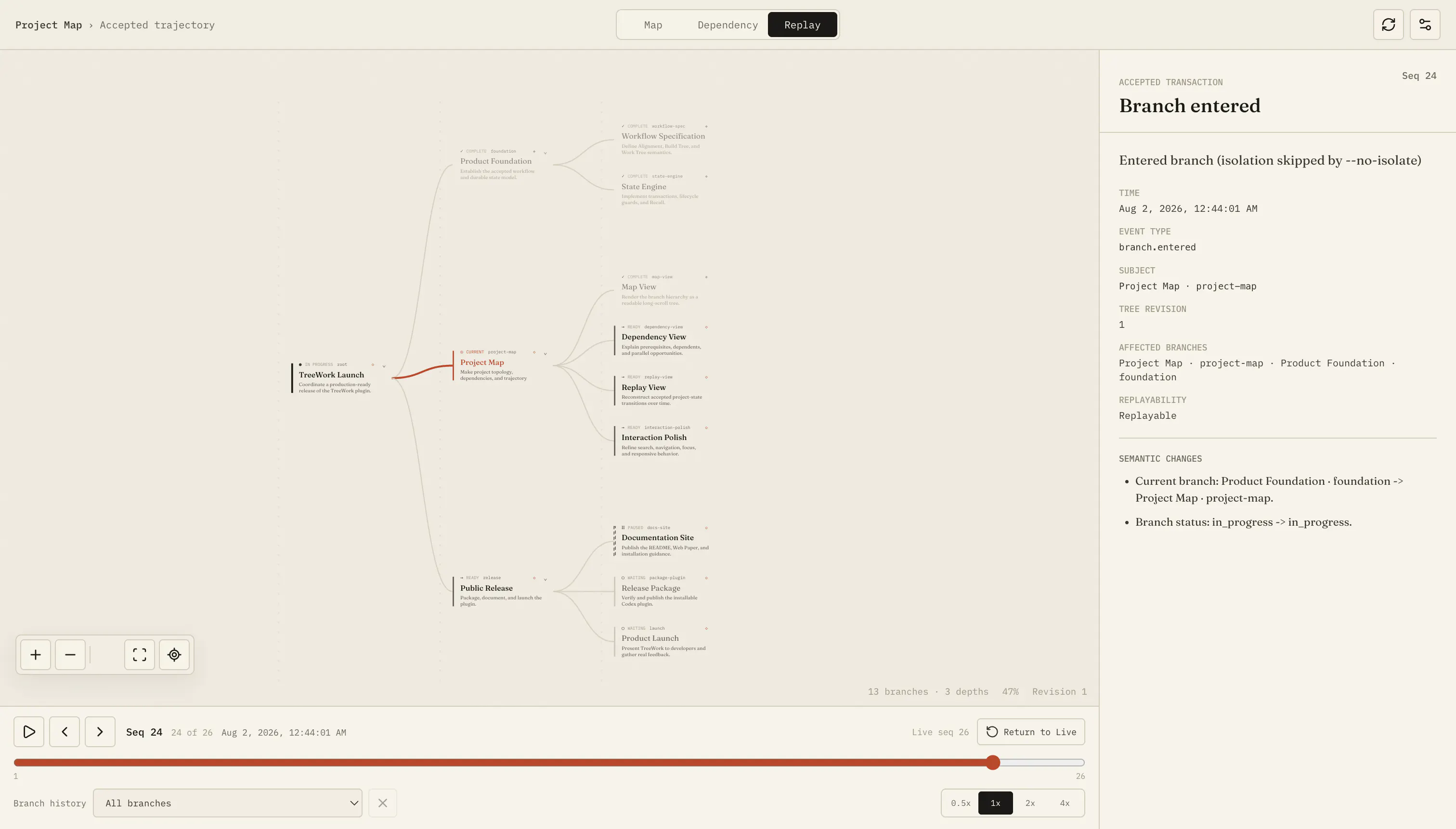
Replay View
TreeWork records semantic transitions, not shell logs. Scrub the accepted project trajectory: tree revisions, branch entries, pauses, verification, and completion. Handoffs and postmortems become inspectable without capturing private reasoning or every code edit.
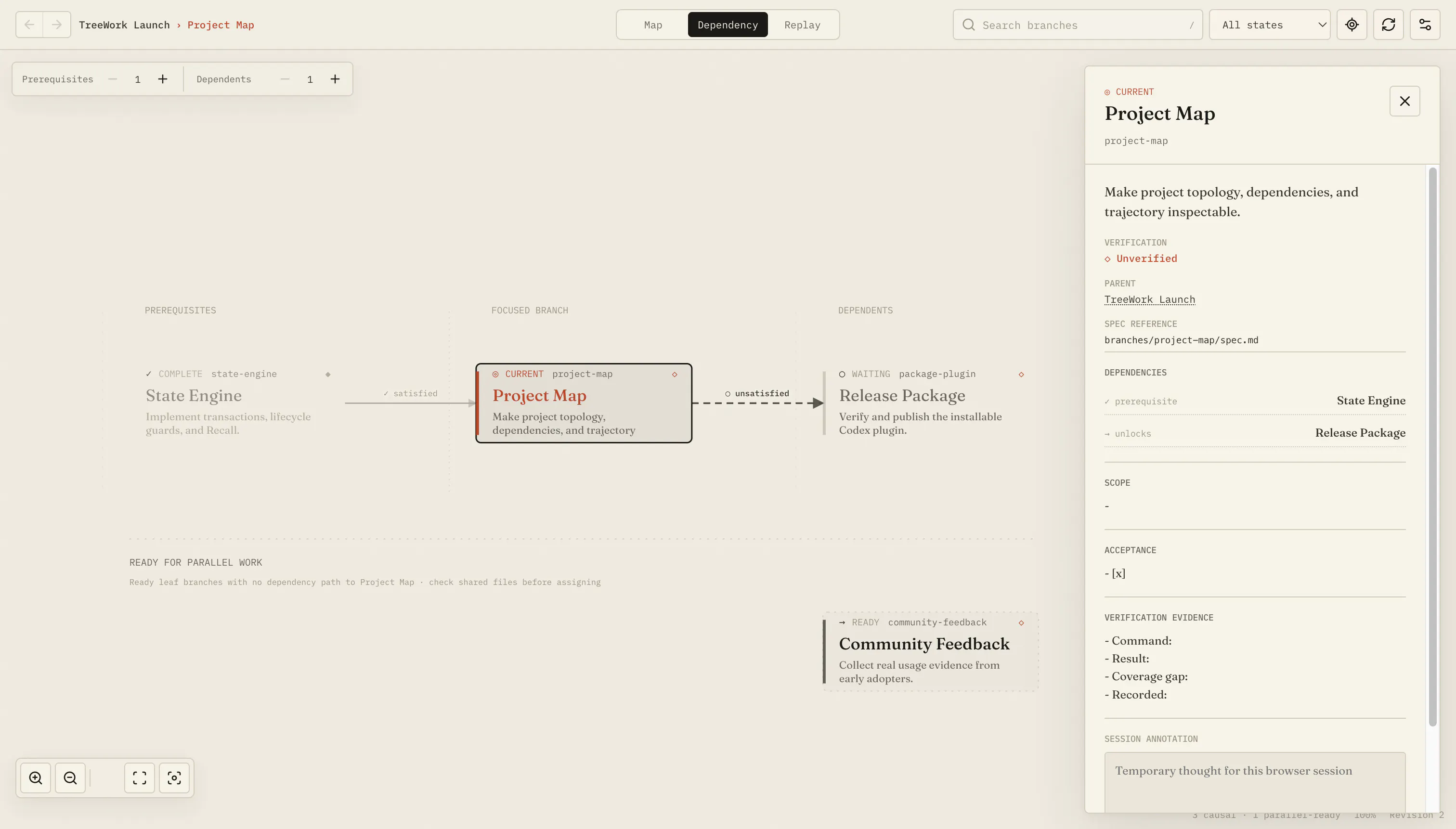
Dependency View
Focus on one branch and see its causal neighborhood: prerequisites, satisfied or unsatisfied dependencies, downstream impact, and work that can proceed in parallel. It answers “why is this blocked?” without flattening the whole project into one unreadable graph.
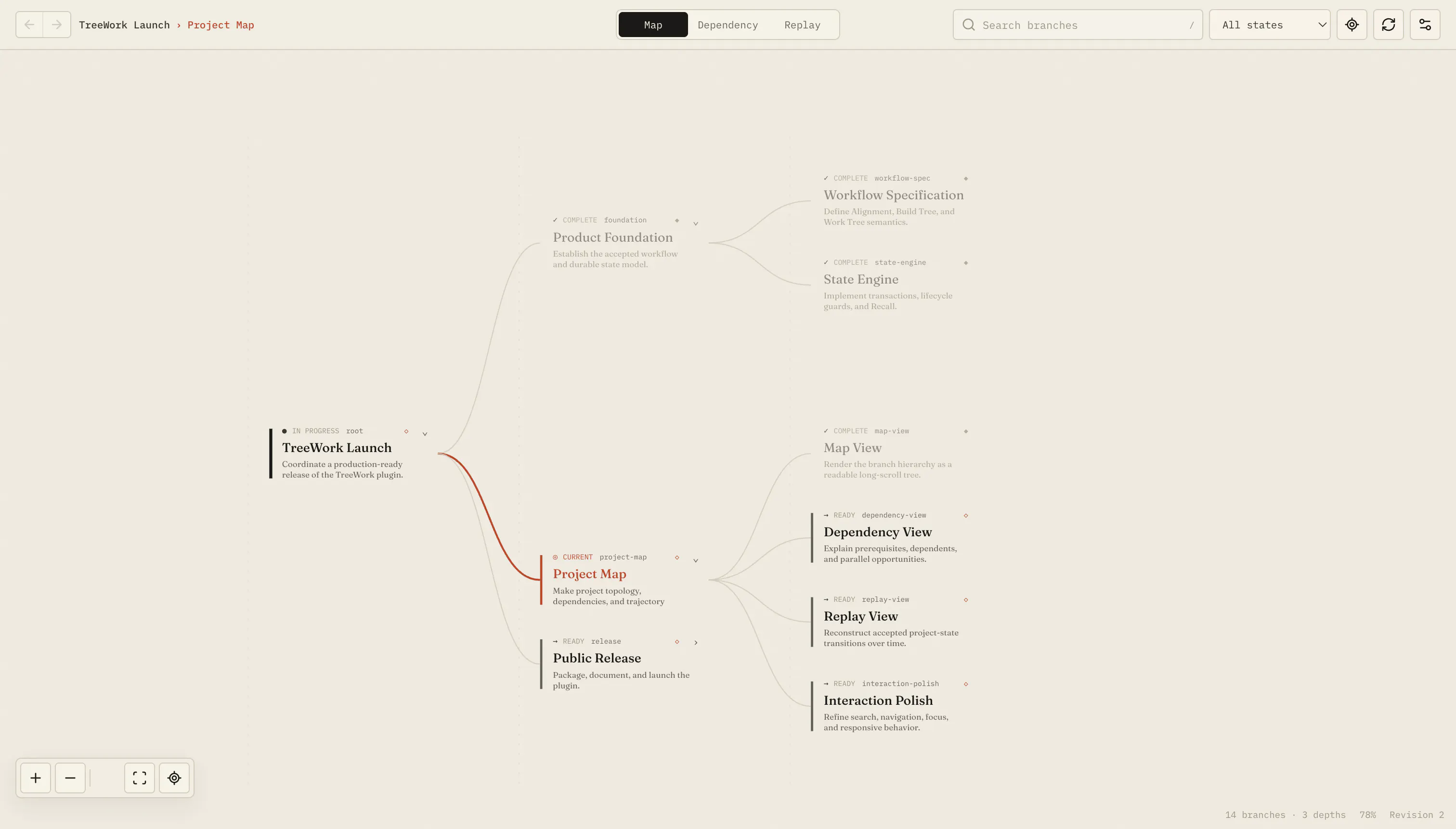
Project Map
See the whole project at a glance: branch hierarchy, lifecycle, readiness, the current route, and what remains. It turns TreeWork’s accepted state into a readable control surface instead of making you reconstruct the project from scattered context.
About TreeWork on Product Hunt
“Tree-guided development for long-running coding agents”
TreeWork was submitted on Product Hunt and earned 5 upvotes and 7 comments, placing #68 on the daily leaderboard. TreeWork is an open-source Codex plugin that gives coding agents a durable map of complex projects. It aligns requirements before coding, organizes work as a branch tree with dependencies, and keeps Spec, Plan, Progress, Findings, Verification, and lifecycle state on each branch. After context compression, interruptions, or handoffs, agents recover accepted project state instead of reconstructing it from code and scattered memories. Includes a CLI, Git worktrees, Project Map, and Web Paper.
TreeWork was featured in Open Source (68.9k followers), Developer Tools (521.1k followers), Artificial Intelligence (481k followers) and GitHub (41.4k followers) on Product Hunt. Together, these topics include over 265.1k products, making this a competitive space to launch in.
Who hunted TreeWork?
TreeWork was hunted by Johnny. A “hunter” on Product Hunt is the community member who submits a product to the platform — uploading the images, the link, and tagging the makers behind it. Hunters typically write the first comment explaining why a product is worth attention, and their followers are notified the moment they post. Around 79% of featured launches on Product Hunt are self-hunted by their makers, but a well-known hunter still acts as a signal of quality to the rest of the community. See the full all-time top hunters leaderboard to discover who is shaping the Product Hunt ecosystem.
Want to see how TreeWork stacked up against nearby launches in real time? Check out the live launch dashboard for upvote speed charts, proximity comparisons, and more analytics.


 Johnny