The Second Brain desktop app gets you running in five minutes. No terminal. No git. Just download, set a password, and sign into Cloudflare. Then the real magic starts. Persistent memory across every AI tool you use. Recall that just got a lot smarter. Surfaces the right memory, not just the newest one. A knowledge graph that builds itself. Your data in your own Cloudflare account, not ours. Mac and Windows. You asked for the app. You asked for better recall. We shipped both.
During our v2 launch, you asked for an easier way. Some mentioned being uncomfortable with git. Others flagged the terminal as a barrier. We listened.
This is the Second Brain desktop app and it exists because of your feedback.
Unlike other memory tools, nothing lives on our servers. Your memories are in your Cloudflare account from day one. We literally can't access them.
Here's what we built: Download. Choose a password. Sign in to Cloudflare (or create a free account if you don't have one, we walk you through it). Five minutes later, your Second Brain is provisioned and running on your machine. No terminal. No git. No technical knowledge required.
You get the full v2 experience, recall-by-meaning, the knowledge graph, all of it, running in a native app on Mac or Windows, pre-authenticated and ready to connect to Claude, Cursor, ChatGPT, and your other tools via MCP.
This is what community-driven product development looks like. Thank you for helping us build this. Now come try it, share your thoughts, and let us know what you think.
@rahilpirani congrats on the launch - very impressive and the "starting over" is a real issue. Why do you think the LLMs force a start over - does it have to do with token usage?
How does it handle large conversation context? Will it clear the older conversation context or it preserves it forever?
Does it go with claude code or codex, I mean in terminal,
I work on multiple side projects over claude code terminal, with this brain can I simply talk about my expectations, it will pick automatically?
The override versus accumulate question above is the real one. Semantic search alone can't answer it either. An old architecture decision and its replacement will usually score just as similar to each other as either does to the query looking for it. That has to get resolved somewhere: at write time, checking new entries against existing ones and versioning what's superseded, or at read time, dumping both into context and trusting the model to notice the contradiction. Which is it here?
Congrats on the launch. How portable is the memory layer if someone later wants to move off Cloudflare? Can they export the raw memories, graph edges, canonical status, and provenance in a format another system can rebuild without losing the relationships?
The line about surfacing the right memory, not just the newest one, is the hard part, and it is good to see it treated as its own feature instead of folded into search.
The thing that usually breaks recall in practice is contradiction over time. March says Postgres, July says SQLite, and pure similarity happily hands back both. Curious whether the knowledge graph does any supersede or invalidate work there, or whether ranking is still semantic distance plus recency.
Keeping the data in the user's own Cloudflare account is the right default too. Congrats on the desktop launch.
I've been hand-maintaining something like this for months — a memory index plus per-topic files I update after every session — and the hardest part isn't storing new context, it's knowing when something old stops being true. A canonical memory that was accurate for a year but describes a relationship or process that's since changed completely — does anything nudge you to review or archive it, or does it just sit as ground truth until a new note happens to contradict it? That's the part that quietly breaks trust in any memory system once it's been running long enough to accumulate stale "facts."
The problem you are solving is so real, I keep re-explaining my whole project to every new chat like it is our first date. One click deploy to Cloudflare sounds lovely. If I use it with both Claude and Cursor, do they share the exact same memory pool or can I split things per tool?
Congrats on shipping this. Self hosted on my own Cloudflare account with MCP support is exactly the setup I want for memory, no third party holding my context. How does the duplicate detection work when two memories say roughly the same thing in different words, does it merge them or keep both?
The trajectory of the usefulness of this tool will only continue to rise as time passes and we have too many tools to count— nice work on this— are you planning on going a similar direction as obsidian or a different one?
that's really clever. how does it handle when two memories contradict each other?
Shipping a desktop installer on top of self-hosted Cloudflare memory removes the git barrier without giving up the your-account data model. Semantic recall plus a graph you can inspect is more useful than dumping the newest note into every chat. How do you scope memories per project or client so Cursor does not pull unrelated brand voice into a new codebase?
I think making the setup frictionless is just as important as improving the memory itself. A lot of developer tools lose people before they ever experience the core value because the first 15 minutes are too much work. Getting someone from download to actually using persistent memory in a few minutes is a bigger improvement than it might seem.
A lot of people have been asking how memories are stored and whether they sync across devices. This diagram explains it better than words can.
The desktop app is how you install and access Second Brain. Your memories live in your own Cloudflare account, not the app and not our servers. Switch from Claude to ChatGPT to Cursor, your brain is already there. Uninstall the app, your memories are still there.
The app is the door. Cloudflare is the house.
@rahilpirani The no-terminal, pre-authenticated setup is a smart move for adoption. One question does the desktop app sync memories in real-time across multiple devices, or is it single-machine only for now?
The your data lives in your own Cloudflare account framing is the part I'd push on, since that's a meaningfully different trust model than most memory tools, but it also means Second Brain's actual behavior depends on a Cloudflare Worker you don't directly control or audit line by line. If the knowledge graph builds itself automatically from what gets stored, is there any way to see or edit what it's inferred about you, or is the graph itself a black box that just quietly shapes what recall surfaces even though the raw memories are yours to inspect.
Also, recall surfacing the right memory instead of just the newest one is a meaningful claim, since relevance ranking is exactly where memory tools tend to either feel magical or frustratingly wrong depending on the query. What happens when two memories genuinely conflict, say you noted a preference one way months ago and then said the opposite more recently, does recall favor recency, relevance to the current prompt, or does it surface both and let the connected AI tool sort it out.
@rahilpirani Congrats, one thing I'm wondering about though, once it's provisioned on your own cloudflare account, how does syncing work across multiple machines, is it pulling from the same cloudflare instance or does each install create its own graph that needs merging. asking because that's usually where "your data, your account" setups get messy.
the frame that made me click 'installed' was 'you asked for the app. you asked for better recall. we shipped both.' thats not a launch line, thats a receipt. congrats on the ship rahil. one thing i noticed poking around: the recall-by-meaning + graph combo is actually the missing shape for cross-tool memory. every other 'memory layer' i've tried just replays chronology. this one thinks in relationships. going to run it against a week of conversations and report what breaks.
congrats on making this a real desktop app - the git/terminal barrier was a legit dealbreaker for a lot of people on the v2 launch. since it's pre-authenticated to Cloudflare on setup, does the app ever need you to re-auth or re-enter your password day to day, or is it truly a one-time five minute setup and then it just runs in the background like any other memory tool from then on?
About Second Brain for Mac and Windows on Product Hunt
“Your AI memory, everywhere you work”
Second Brain for Mac and Windows launched on Product Hunt on July 25th, 2026 and earned 275 upvotes and 45 comments, earning #3 Product of the Day. The Second Brain desktop app gets you running in five minutes. No terminal. No git. Just download, set a password, and sign into Cloudflare. Then the real magic starts. Persistent memory across every AI tool you use. Recall that just got a lot smarter. Surfaces the right memory, not just the newest one. A knowledge graph that builds itself. Your data in your own Cloudflare account, not ours. Mac and Windows. You asked for the app. You asked for better recall. We shipped both.
Second Brain for Mac and Windows was featured in Productivity (662k followers), Developer Tools (520.4k followers), Artificial Intelligence (479.9k followers) and GitHub (41.4k followers) on Product Hunt. Together, these topics include over 405.6k products, making this a competitive space to launch in.
Who hunted Second Brain for Mac and Windows?
Second Brain for Mac and Windows was hunted by fmerian. A “hunter” on Product Hunt is the community member who submits a product to the platform — uploading the images, the link, and tagging the makers behind it. Hunters typically write the first comment explaining why a product is worth attention, and their followers are notified the moment they post. Around 79% of featured launches on Product Hunt are self-hunted by their makers, but a well-known hunter still acts as a signal of quality to the rest of the community. See the full all-time top hunters leaderboard to discover who is shaping the Product Hunt ecosystem.
Reviews
Second Brain for Mac and Windows has received 2 reviews on Product Hunt with an average rating of 4.00/5. Read all reviews on Product Hunt.
Want to see how Second Brain for Mac and Windows stacked up against nearby launches in real time? Check out the live launch dashboard for upvote speed charts, proximity comparisons, and more analytics.


 fmerian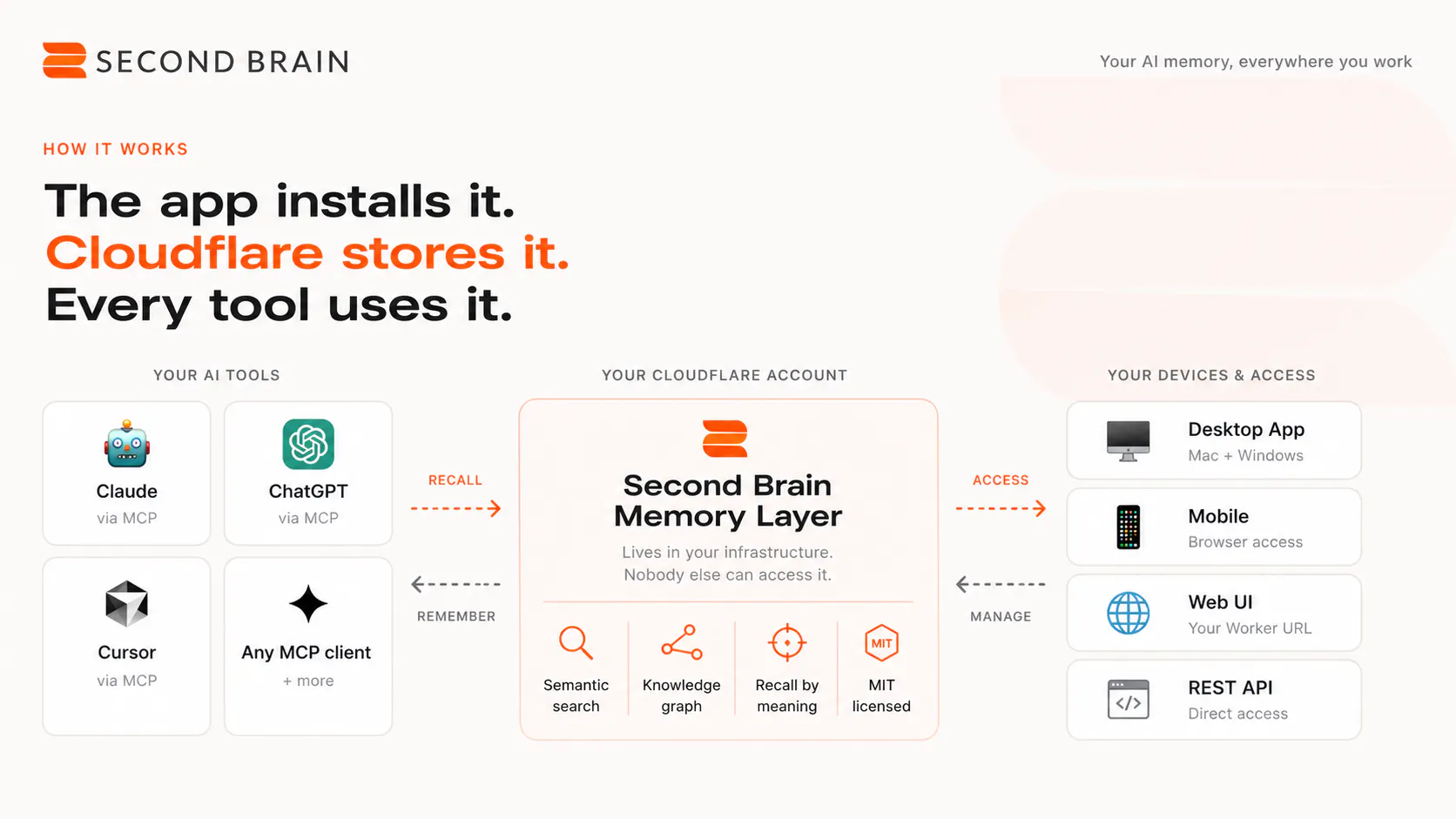
During our v2 launch, you asked for an easier way. Some mentioned being uncomfortable with git. Others flagged the terminal as a barrier. We listened.
This is the Second Brain desktop app and it exists because of your feedback.
Unlike other memory tools, nothing lives on our servers. Your memories are in your Cloudflare account from day one. We literally can't access them.
Here's what we built: Download. Choose a password. Sign in to Cloudflare (or create a free account if you don't have one, we walk you through it). Five minutes later, your Second Brain is provisioned and running on your machine. No terminal. No git. No technical knowledge required.
You get the full v2 experience, recall-by-meaning, the knowledge graph, all of it, running in a native app on Mac or Windows, pre-authenticated and ready to connect to Claude, Cursor, ChatGPT, and your other tools via MCP.
This is what community-driven product development looks like. Thank you for helping us build this. Now come try it, share your thoughts, and let us know what you think.