Your agent knows Kubernetes. It doesn't know your cluster. Radar (open-source) gives it context over MCP: ranked issues, a change timeline, logs and owners in one view. New: click Investigate on a failing workload. Claude Code, Codex or Cursor finds the root cause, read-only, with evidence for each claim. In our benchmark of 50 live faults across six tools, Radar found the most root causes. Radar Cloud investigates every alert and posts findings to Slack.
Hey Product Hunt, Nadav here, one of the people behind Radar.
We launched Radar here in May as an open-source Kubernetes UI. Unsurprisingly, more and more people have been telling us since then that they want to point their AI agents at their clusters. Agents have become really smart, but they burn a lot of time and tokens poking around the cluster with kubectl to understand what’s going on and piecing together the puzzle - and even then often miss the change that someone made ten minutes before things broke.
Radar's MCP server gives your agent (Claude Code, Codex, Cursor, Copilot, etc) the cluster already put together: issues detected, a history of events and changes to Kubernetes resources, topology and relationships between objects, logs and metrics.
We benchmarked it - same agent with Radar found root cause 3x (!) faster and 80% cheaper than with plain kubectl.
Click Investigate on any issue and Radar runs your own agent CLI, read-only, on your machine. You get the root cause, the evidence for each claim, and a fix that runs only if you approve it. Radar Cloud does the same when it detects an issue or an alert fires, and posts the answer to Slack.
We also ran six AI SRE tools on 50 live faults. Claude Code on Radar's MCP got 44 right, the most of the six, and was the fastest and cheapest. Method and every run: https://radarhq.io/benchmark/ai-sre-tools
Radar is free and open source, Apache 2.0:
brew install kubectl-radar
How do you debug your clusters today, and what would you want an agent to take on next?
open source k8s ui plus mcp is a nice combo 👏 do u see more teams or solo devs using it?
Clearly answers a real need, I liked the approach. curious to see how this evolves
does the redaction also apply to logs pulled through /mcp-readonly, not just when Investigate runs
The ranked-issues view is the part I'd want to poke at first. When the MCP gives the agent ranked issues together with the change timeline, logs, and owners, what sets the ranking — is it mainly severity and recency, or does a change in the timeline, like a deploy just before the failure, push an issue up the list?
The read-only-until-approved default is the right way to let an agent near a cluster. On the 50-fault benchmark, did the six misses cluster around one failure type, or were they just noise?
Many congratulations team! Quick one- How well does Radar work when something goes wrong across multiple clusters? Can it actually pinpoint the root cause, or does it still need an engineer to dig into the logs?
Read-only investigation with evidence for each claim is a good call. I'd be much more comfortable letting an agent investigate production issues that way. Also, the change timeline sounds especially useful. Congratulations!
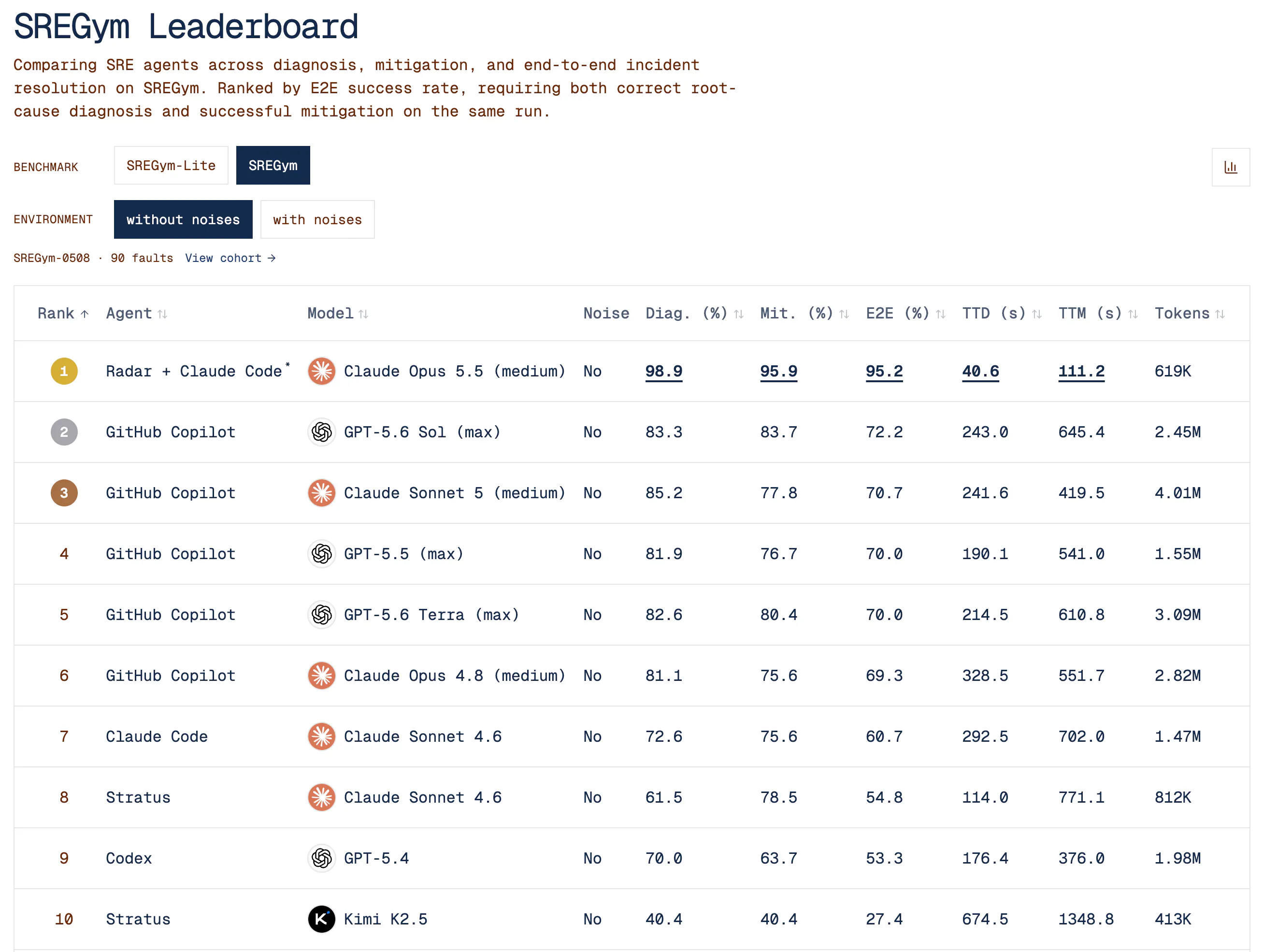
Fresh news: Radar is now #1 on SREGym benchmark: https://sregym.com And it's not even close 😅
The change timeline is the part I'd look at first. Seeing what changed just before a workload failed gives the investigation somewhere to start.
publishing every run of the 50 fault benchmark, misses included, is waht made me trust the 44 lol
when Investigate runs Claude Code on my machine, do logs with secrets in them go to the model as is??? or is there some redaction before the agent sees them???
About Radar on Product Hunt
“You don't need an AI SRE. Give your agent Radar.”
Radar launched on Product Hunt on October 29th, 2026 and earned 124 upvotes and 22 comments, placing #8 on the daily leaderboard. Your agent knows Kubernetes. It doesn't know your cluster. Radar (open-source) gives it context over MCP: ranked issues, a change timeline, logs and owners in one view. New: click Investigate on a failing workload. Claude Code, Codex or Cursor finds the root cause, read-only, with evidence for each claim. In our benchmark of 50 live faults across six tools, Radar found the most root causes. Radar Cloud investigates every alert and posts findings to Slack.
Radar was featured in Open Source (69k followers), Developer Tools (522.3k followers), Artificial Intelligence (482.7k followers) and GitHub (41.5k followers) on Product Hunt. Together, these topics include over 277k products, making this a competitive space to launch in.
Who hunted Radar?
Radar was hunted by Nadav Erell. A “hunter” on Product Hunt is the community member who submits a product to the platform — uploading the images, the link, and tagging the makers behind it. Hunters typically write the first comment explaining why a product is worth attention, and their followers are notified the moment they post. Around 79% of featured launches on Product Hunt are self-hunted by their makers, but a well-known hunter still acts as a signal of quality to the rest of the community. See the full all-time top hunters leaderboard to discover who is shaping the Product Hunt ecosystem.
Want to see how Radar stacked up against nearby launches in real time? Check out the live launch dashboard for upvote speed charts, proximity comparisons, and more analytics.


 Nadav Erell
Hey Product Hunt, Nadav here, one of the people behind Radar.
We launched Radar here in May as an open-source Kubernetes UI. Unsurprisingly, more and more people have been telling us since then that they want to point their AI agents at their clusters. Agents have become really smart, but they burn a lot of time and tokens poking around the cluster with kubectl to understand what’s going on and piecing together the puzzle - and even then often miss the change that someone made ten minutes before things broke.
Radar's MCP server gives your agent (Claude Code, Codex, Cursor, Copilot, etc) the cluster already put together: issues detected, a history of events and changes to Kubernetes resources, topology and relationships between objects, logs and metrics.
We benchmarked it - same agent with Radar found root cause 3x (!) faster and 80% cheaper than with plain kubectl.
Click Investigate on any issue and Radar runs your own agent CLI, read-only, on your machine. You get the root cause, the evidence for each claim, and a fix that runs only if you approve it. Radar Cloud does the same when it detects an issue or an alert fires, and posts the answer to Slack.
We also ran six AI SRE tools on 50 live faults. Claude Code on Radar's MCP got 44 right, the most of the six, and was the fastest and cheapest. Method and every run: https://radarhq.io/benchmark/ai-sre-tools
Radar is free and open source, Apache 2.0:
How do you debug your clusters today, and what would you want an agent to take on next?