I built MusiKey because I was tired of the same password paradigm we've been stuck with for decades. What if authentication wasn't just secure, but actually beautiful?
MusiKey generates a unique encrypted musical composition for every user. Your identity isn't a string of characters — it's a song. Enrollment creates a scale-constrained melody using cryptographic randomness, encrypts it through a cascaded PBKDF2 + scrypt pipeline, then seals it with double-layer AES-256-GCM. To authenticate, your passphrase reverses the process — if the decrypted data passes a four-dimensional musicality analysis (harmonic consonance, melodic smoothness, rhythmic regularity, and scale adherence), you're in. If not, you hear nothing. Five failures and the credential self-destructs — overwritten with random data, gone forever.
The idea started as a kernel module inside a hobby OS I've been building. I liked it enough to pull it out into a standalone cross-platform app. Zero runtime dependencies. All crypto runs on native platform APIs. The songs actually sound good.
Please see my website at: musikey.org for more information
UPDATE: Feb 27 2026
I added MiDI interface for MusiKey so individuals can hook their instruments to it.
MusiKey — Musical Entropy Authentication
MusiKey replaces passwords with music. Instead of memorizing strings of characters, you authenticate with a unique musical composition that doubles as a cryptographic key.
The problem: Passwords are weak, reused, and forgettable. Hardware tokens are expensive and losable. Biometrics can't be changed if compromised.
The solution: MusiKey generates a random musical composition tied to your passphrase. The composition itself becomes your cryptographic credential — something you can hear, recognize, and verify, but that carries 112+ bits of entropy. If compromised, just generate a new song.
What it does:
Generates unique musical compositions as authentication credentials
Encrypts them with cascaded KDF (PBKDF2 + Argon2id) and double AES-256-GCM
Acts as an authenticator for external services via ECDSA P-256 signed challenge-response (MusiKey Protocol) — a more secure alternative to TOTP codes
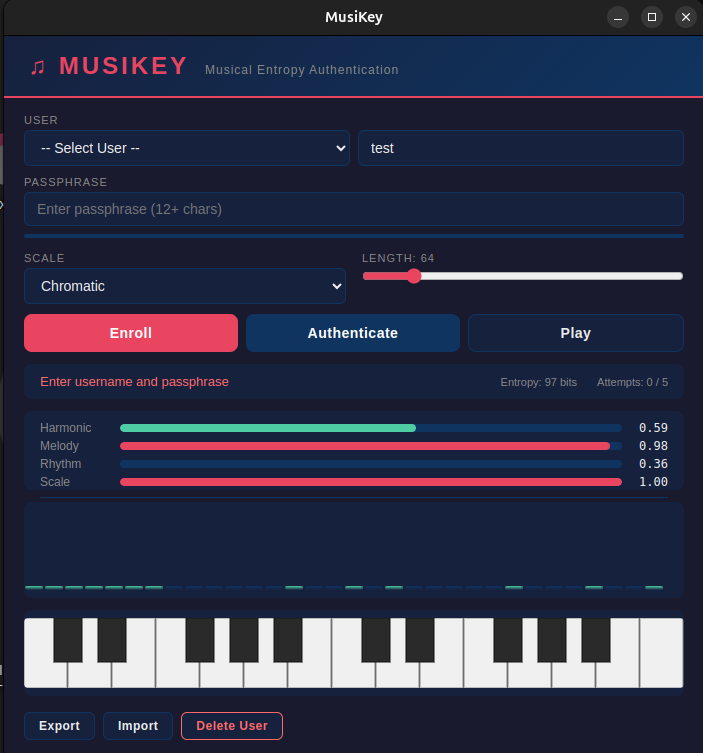
Visual fingerprint lets you visually confirm your credential at a glance
Self-destructs after 5 failed attempts — no brute forcing
Full audit log with tamper detection
What it isn't: MusiKey isn't a password manager or a music app. It's a proof of concept that musical structure can carry enough entropy to be cryptographically useful, while being more human-recognizable than a random string.
All processing is local. Nothing leaves your machine. Zero runtime dependencies. Open source.
Update on Feb 27 , 2026: MusiKey turns music into cryptographic keys. Generate a unique composition, and it becomes your authentication credential — encrypted with cascaded KDF (PBKDF2 + Argon2id) and double AES-256-GCM. Features ECDSA P-256 challenge-response authentication for external services, multi-factor auth (musical challenge-response + TOTP), visual fingerprint verification, tamper-detected audit logging, and self-destructing credentials after failed attempts. Zero runtime dependencies — all crypto via platform APIs. Open source, fully local, nothing leaves your machine.
Fascinating idea. It could do with a little more explanation and UI tweaks - I could generate compositions but couldn't work out if there were other things it should also be able to do.
Also I think the shown keyboard is an octave shorter than the range of the generated notes (low notes appeared on the indicator about the keyboard, but not on the keyboard itself).
Edit to add: Also this could be deployed directly as a web app for demo purposes (using browser storage instead of file storage), rather than getting people to download and install a git repo.
Congrats on the launch! Shipping a desktop app with solid auth is no small feat. I saw the GitHub repo, what license are you plan to use (MIT, etc.)?
About Musikey on Product Hunt
“Tough musical authentication for accessibility ”
Musikey launched on Product Hunt on February 27th, 2026 and earned 85 upvotes and 11 comments, placing #19 on the daily leaderboard. Musical Authentication uses a musical key instead of a password for authentication
Musikey was featured in Music (53.7k followers), Privacy (11.4k followers) and Security (3k followers) on Product Hunt. Together, these topics include over 28k products, making this a competitive space to launch in.
Who hunted Musikey ?
Musikey was hunted by Graham Hartridge. A “hunter” on Product Hunt is the community member who submits a product to the platform — uploading the images, the link, and tagging the makers behind it. Hunters typically write the first comment explaining why a product is worth attention, and their followers are notified the moment they post. Around 79% of featured launches on Product Hunt are self-hunted by their makers, but a well-known hunter still acts as a signal of quality to the rest of the community. See the full all-time top hunters leaderboard to discover who is shaping the Product Hunt ecosystem.
Want to see how Musikey stacked up against nearby launches in real time? Check out the live launch dashboard for upvote speed charts, proximity comparisons, and more analytics.

 Graham Hartridge