This product was not featured by Product Hunt yet. It will not be visible on their landing page and won't be ranked (cannot win product of the day regardless of upvotes).
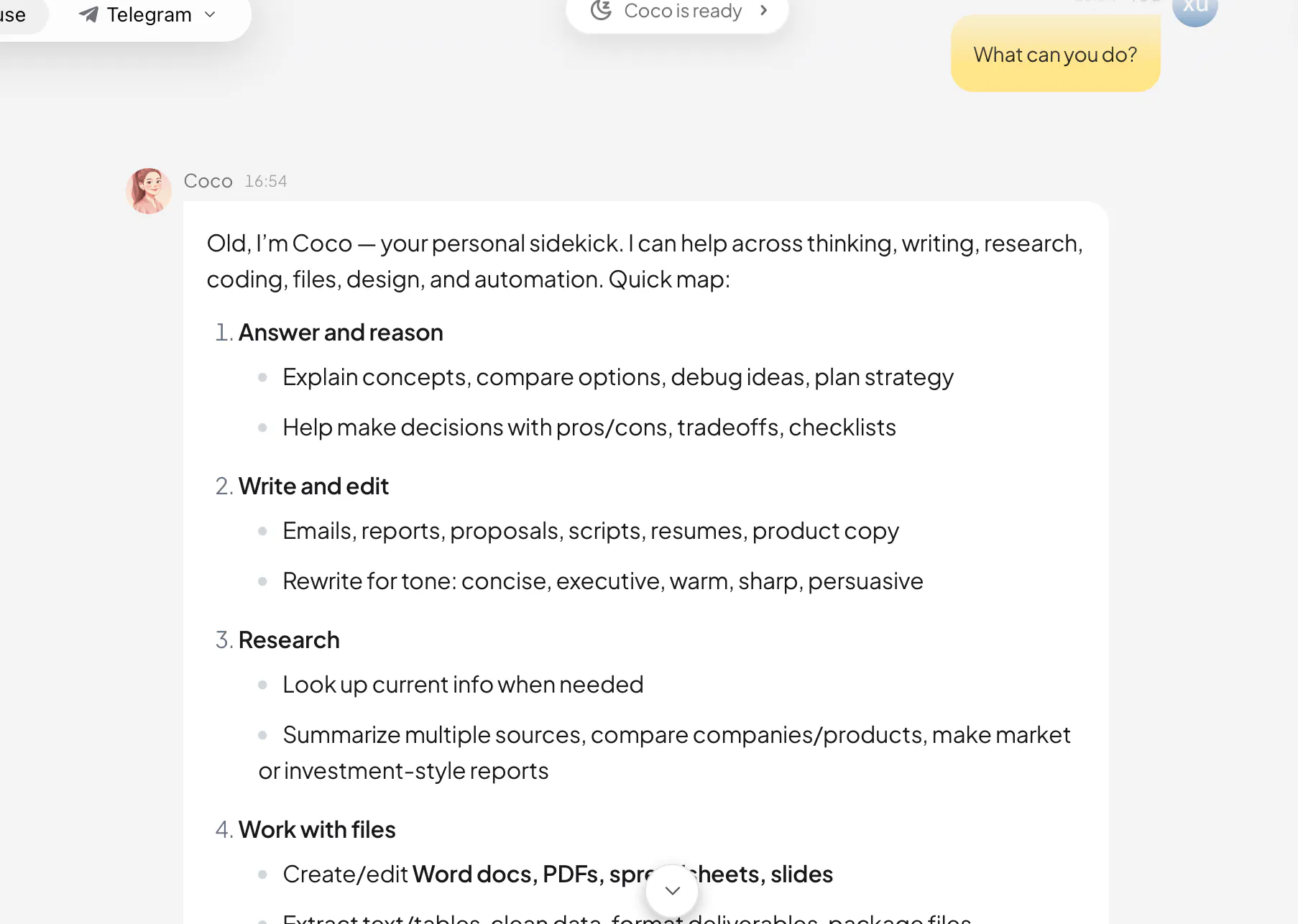
Muse is a personal AI assistant that feels less like software and more like a real assistant who knows how you work. It remembers your context, preferences, projects, people, boundaries, and past feedback, connects to the tools where your work lives, and turns messy inputs into polished deliverables. Instead of starting from scratch every time, Muse carries the relationship forward — asking what’s missing, following through, and helping real work move faster with less effort.
Hi Product Hunt 👋
I’m Wu, Product Lead at Muse.
We built Muse around a simple belief: working with AI shouldn’t require learning new modes, sessions, or prompt rituals.
With a real assistant, you don’t rebuild context from scratch every time. You just say what you need, and the assistant picks up the background, asks what’s missing, and helps move the work forward.
That’s what we want Muse to feel like.
Muse is a personal AI assistant that remembers how you work — your context, projects, preferences, people, boundaries, and past feedback. It connects to the tools where your work lives and helps turn messy inputs into finished work: reports, briefs, plans, docs, follow-ups, and more.
Muse is live now and free to start. Free users get daily credits, and paid plans are available when you need more capacity.
We’d love your feedback on three things:
1. Does Muse feel different from chatbots or agents you have to manage?
2. What work would you delegate to a personal AI assistant first?
3. What would make you trust Muse with real work?
We’ll be here all day answering questions.
Disclaimer: this is not a paid post. Nobody sent me a unit. No one PR'd me.I just used it for a week and I'm physically unable to shut up about it — and the target of my yelling isn't Muse, it'sthe twenty other AI coworkers I've used over the past two years.
They all share the same disease. I say "I'm a bit cold" and the thing immediately puts my coat on, closes the window, and pours me a hot drink. This is what I call"pick-me" AI energy— desperately trying to prove it's useful, terrified you'll close the tab.
Muse doesn't do that.
Thing one: it has the audacity to not listen to me.I asked it to clean up an interview transcript. It didn't quietly rewrite my phrasing. I asked for an email draft. It didn't "optimize" my tone behind my back. I thought it was broken. Then I dug into its settings and realized —restraint is the factory default, not a feature bolted on later.In 2026, when AI tools collectively suffer fromyes-man syndrome, this is straight-upgaslighting the entire industry into thinking AI has to be this eager to please.
Thing two: it remembers but it shuts up about it.I used it for a full week. Not once did it pop up and say "by the way, you said this three weeks ago~". Then one day I casually mentioned a project from three months ago — and it just picked right up.Real ones don't need to remind you they're paying attention.That hit different.
Thing three: it has the guts to leave the UI empty.The whole interface looks like a regular note-taking app. No chat panel on the left. No plugin drawer on the right. No floating orb at the bottom. When you open something called an "AI coworker" and see nothing but a minimalist input box —it gives me "calm down, I'm not that kind of app" vibes.In an era when every AI tool wants to be"your everything app,"this is genuinely the rarest energy out there.
The moment that wrecked me was last Friday. Working late, I typed: "Do you still remember that thing I said I wanted to do last month?" It didn't pull up a timeline. Didn't throw a link at me. Didn't reply with"Great question! Let me help you with that..."in that fake-polite customer-service voice. Just a short paragraph —in almost exactly the way I'd said it back then.
I stared at that paragraph for a long time. Honestly, as someone who's pretty much numb to AI tools at this point, what wrecked me wasn't what Muse can do. It made me believe one small thing again:all those scattered things I said out loud were actually being heard— even if what heard them was an AI.
Go to museai.im. Try it yourself. You're welcome.And again —no one paid me for this.If they had, the post would be way worse.
@zeus_wusir@zhangliang_yang One thing I appreciated from your launch post is that you’re focusing on reducing the amount of AI management people have to do instead of adding more prompts and more modes.
My question is around trust. Once Muse has access to emails, documents and other tools, how transparent is it about why it makes a recommendation or pulls in a particular piece of context? I think being able to understand why it surfaced something becomes really important as an assistant becomes more deeply integrated into daily work.
@zeus_wusir I like the idea of treating an AI as a long-term assistant instead of starting every conversation from scratch. That’s probably the biggest frustration with most AI tools today.
One thing I’m wondering about is how Muse decides what context is still relevant after weeks or months of usage. People’s priorities, projects and working styles change over time. How do you prevent old context from becoming noise without forcing users to constantly clean up or reset their memory?
The persona feature looks so interesting! Most agent-style products focus on productivity but often overlook personalization (or memory—I haven't played with yours enough yet to judge lol). If you guys can actually balance these two well, that'd be pretty awesome!
Really cool take on personal intelligence. My biggest headache with similar tools is 'context bloat'—the AI tries to remember literally everything, so it gets totally confused and drags up irrelevant stuff from months ago. How does Muse actually filter what's worth keeping versus what's just noise? Does it have a smart way to manage its own memory?
Quick question: is it mainly a local setup or cloud-based? And can it manage local files/projects kinda like Claude Code does?
Hi everyone, I’m the backend lead for Muse AI, and I’m excited to introduce the product we’ve just launched.
Muse is a new kind of AI assistant. It’s simple, fast, and easy to use — and more importantly, it has long-term memory. Muse can understand your habits, remember your needs, and help you efficiently summarize, organize, and make sense of information.
Our goal is for Muse to become the most natural and reliable intelligent assistant by everyone’s side.
Honestly curious—if Muse has been watching me work for a year, would it eventually just... tell me things? Like Monday morning, 'yo, here's what matters this week'? That'd be wild.
Hi team!
I’m an investor from Vietnam and ur app looks interesting. Just curious — how do u handle user data privacy, like storage, protection, and deletion? Thanks!
In MUSE, we designed 30 AI assistants with different personalities, looks, and working styles. The reason is simple: a real assistant should not feel the same for everyone. Your work habits are different. Your assistant should be different too.
Hi Product Hunt community 👋
I’m a product maker working on Muse, mainly focusing on product experience and how Muse can support people in their day-to-day work.
One thing I really appreciate about Product Hunt is that people here don’t just look at what a product claims to do — they ask whether it is actually useful in real situations.
That’s also the lens I use when thinking about Muse. For me, the key question is not only “Can AI give me a good answer?” but “Can AI help me organize scattered context and produce something concrete, like a research brief, a launch plan, or a clear summary?”
Muse is being built around that idea: understanding context, working with connected tools, adapting to personal working styles, and producing real deliverables.
I’d love to hear which work tasks you would want Muse to support first — research, planning, summarizing, writing, or something else that current AI tools still make difficult.
You shouldn’t have to re-explain your work every time you open an AI tool.
Muse remembers what matters — your context, preferences, projects, people, and past decisions — then helps you write, plan, summarize, search, and get things done across your workflow.
It’s not just an AI chat box.
It’s a personal AI coworker that gets work done with you.
MuseAI is live on ProductHunt today.
As the technical lead, what excites me most is not building “another AI chat tool,” but exploring a new form of personal intelligence — one that can understand long-term goals, remember what matters, stay aware of context, and help people turn intent into action.
Over the past few months, we’ve been focused on several hard problems: How can AI remember only what truly matters? How can it maintain continuity across tasks and conversations? How can tool use, content generation, and task execution become a reliable system instead of a one-off demo?
MuseAI is still early, but today is an important milestone.
Grateful to our team, early users, and everyone who has supported us along the way. If this direction resonates with you, we’d love your feedback and support on ProductHunt.
About Muse AI on Product Hunt
“Your personal AI assistant that gets work done”
Muse AI was submitted on Product Hunt and earned 10 upvotes and 29 comments, placing #62 on the daily leaderboard. Muse is a personal AI assistant that feels less like software and more like a real assistant who knows how you work. It remembers your context, preferences, projects, people, boundaries, and past feedback, connects to the tools where your work lives, and turns messy inputs into polished deliverables. Instead of starting from scratch every time, Muse carries the relationship forward — asking what’s missing, following through, and helping real work move faster with less effort.
Muse AI was featured in Productivity (663.6k followers) and Artificial Intelligence (481.6k followers) on Product Hunt. Together, these topics include over 301.3k products, making this a competitive space to launch in.
Who hunted Muse AI?
Muse AI was hunted by Zeus Wusir. A “hunter” on Product Hunt is the community member who submits a product to the platform — uploading the images, the link, and tagging the makers behind it. Hunters typically write the first comment explaining why a product is worth attention, and their followers are notified the moment they post. Around 79% of featured launches on Product Hunt are self-hunted by their makers, but a well-known hunter still acts as a signal of quality to the rest of the community. See the full all-time top hunters leaderboard to discover who is shaping the Product Hunt ecosystem.
Want to see how Muse AI stacked up against nearby launches in real time? Check out the live launch dashboard for upvote speed charts, proximity comparisons, and more analytics.


 Zeus Wusir