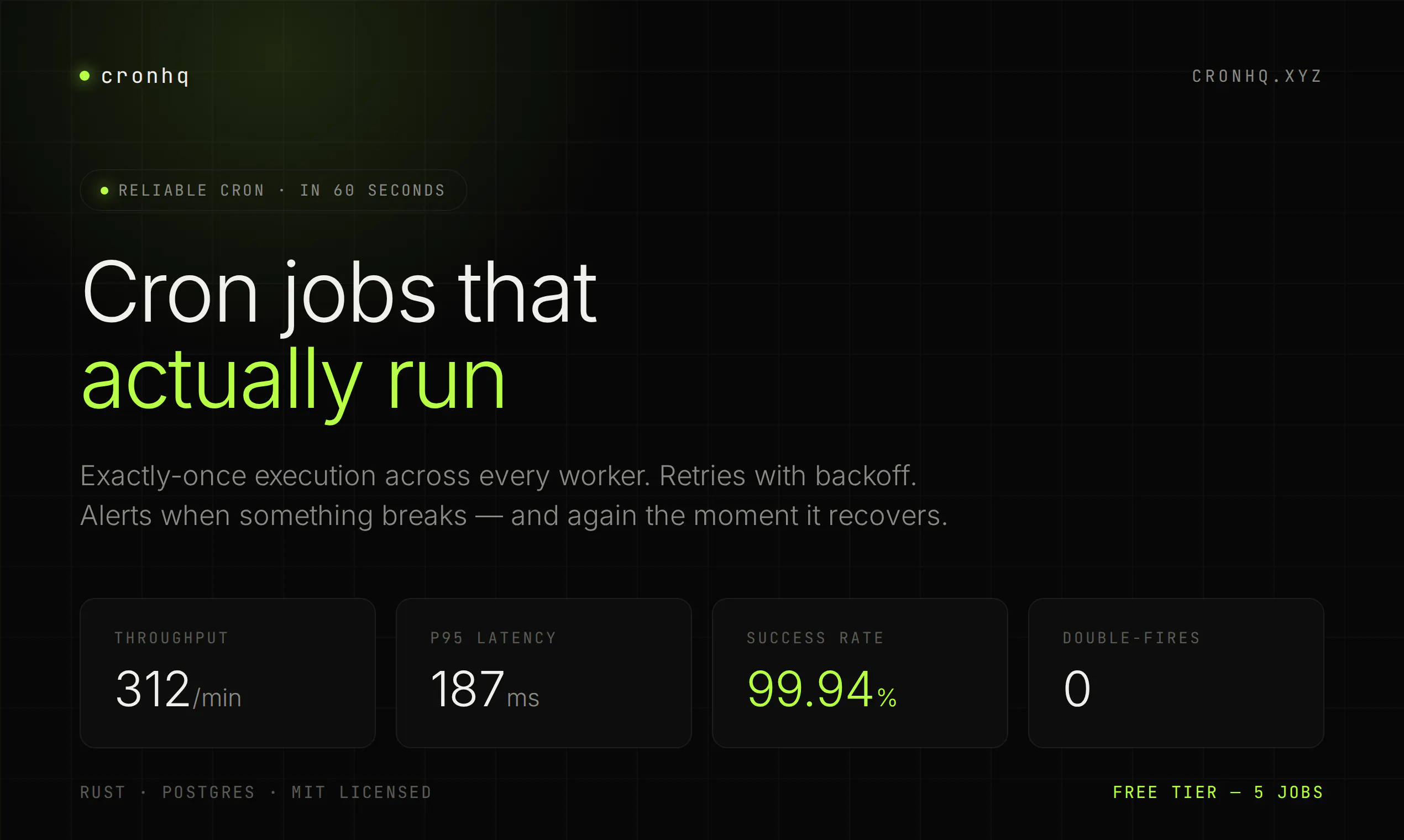
Cron jobs fail in silence. Two servers run the same crontab and your billing job fires twice. A job dies and nobody notices for weeks. Cronhq is a scheduler built around one guarantee: exactly-once execution, enforced by Postgres locks — not best-effort. Around it: retries with backoff, HMAC-signed webhooks, heartbeat monitors for jobs we don't run, and alerts that fire once on failure and once on recovery. Rust on Postgres. MIT-licensed, self-hostable, same image we run. Free tier: 5 jobs.
Hi Product Hunt 👋
I'm Michael, and I built Cronhq alone over the past several months.
It started with a bug I kept watching people hit at client gigs. A team
scales their app from one box to two. Both boxes have the same crontab.
The nightly billing job now runs twice, and a customer gets charged
twice. Nobody finds out from a dashboard — they find out from an angry
support ticket.
The other half of it is quieter and worse: a job that just stops. No
crash, no page, no alert. Six weeks later someone notices the reports
have been empty since March.
Cronhq is my attempt to make both of those failures structurally hard
instead of merely unlikely.
What's under the hood:
→ Exactly-once execution. Every due run is claimed through a Postgres
lock row with an expiry deadline, and next_run_at moves forward
BEFORE dispatch. Two workers cannot fire the same run. If a worker
dies holding the lock, the expiry lets another one take over rather
than the run being lost.
→ Retries with backoff, per job — max attempts, delay and timeout are
config, not a try/except you copy-pasted from Stack Overflow.
→ Alerts that dedup on transitions, not state. One alert when a job
starts failing, one when it recovers. Not 47 pages at 3am.
→ Signed webhooks. HMAC-SHA256 over timestamp.body, with per-job
secrets you can rotate without downtime, so your endpoint can prove
the request came from us.
→ Heartbeat monitors — a dead-man's switch for jobs we DON'T run. Ping
a URL from your existing cron; if the ping doesn't land inside the
window, you get alerted. Absence is the thing that's hard to detect.
→ Cron-as-code. Put your schedules in cronhq.yaml, run `npx cronhq
sync`, and `npx cronhq tail` to watch executions stream live.
The stack is Rust (axum + sqlx + tokio) for the scheduler, worker and
API, Postgres as the only coordination primitive, no Redis, no Kafka,
no scheduler-of-schedulers — and a Next.js dashboard.
It's MIT licensed and self-hostable with one docker-compose. The
self-hosted image is the same image the cloud runs; there are no
features hidden behind a flag. Free tier is 5 jobs, paid starts at $5.
Two things I'd genuinely love your take on:
1. Is "exactly-once" the right thing to lead with, or does it read as
too in-the-weeds outside of backend circles?
2. What would you need to see before you'd trust this with a job that
actually moves money?
I'll be here all day answering everything. Thanks for reading 🙏
the "job runs twice" framing is exactly the failure mode that's easy to ignore until it hits a billing job specifically. Curious how the Postgres lock holds up under a worker crash mid-job - does the lock get released automatically so the next scheduled run can pick it up, or does a dead worker leave a job stuck until someone notices via the heartbeat alert?
This is very useful. This has been a bugbear of mine for a long time. Well done.
About Cronhq on Product Hunt
“Cron jobs that actually run”
Cronhq launched on Product Hunt on September 21st, 2026 and earned 93 upvotes and 12 comments, placing #12 on the daily leaderboard. Cron jobs fail in silence. Two servers run the same crontab and your billing job fires twice. A job dies and nobody notices for weeks. Cronhq is a scheduler built around one guarantee: exactly-once execution, enforced by Postgres locks — not best-effort. Around it: retries with backoff, HMAC-signed webhooks, heartbeat monitors for jobs we don't run, and alerts that fire once on failure and once on recovery. Rust on Postgres. MIT-licensed, self-hostable, same image we run. Free tier: 5 jobs.
Cronhq was featured in Open Source (69k followers), SaaS (44.9k followers), Developer Tools (521.5k followers) and GitHub (41.4k followers) on Product Hunt. Together, these topics include over 198.5k products, making this a competitive space to launch in.
Who hunted Cronhq?
Cronhq was hunted by Michael Sunmisola. A “hunter” on Product Hunt is the community member who submits a product to the platform — uploading the images, the link, and tagging the makers behind it. Hunters typically write the first comment explaining why a product is worth attention, and their followers are notified the moment they post. Around 79% of featured launches on Product Hunt are self-hunted by their makers, but a well-known hunter still acts as a signal of quality to the rest of the community. See the full all-time top hunters leaderboard to discover who is shaping the Product Hunt ecosystem.
Want to see how Cronhq stacked up against nearby launches in real time? Check out the live launch dashboard for upvote speed charts, proximity comparisons, and more analytics.

 Michael Sunmisola