Computable GPU Index (CGI) is a USD price per GPU-hour, computed from the published on-demand rental rates of a fixed panel of providers. The methodology is mathematically robust, and anyone can verify and reproduce every print.
Hi Product Hunt, I'm Ray, cofounder of Computable.
What is the price of a GPU?
Nobody agrees. Every provider quotes a different number, and existing indexes are closed black boxes: a figure you are asked to trust without seeing the data, the method, or the code behind it. Despite being rented, resold, and financed at commodity scale, compute lacks the reference rate every mature commodity market has.
CGI is built to be that number, and to earn trust in the open rather than by authority. It is open data, open method, open code.
How it works: every 15 minutes we collect published on-demand rental rates from 28 providers. Each panel provider casts weighted votes at its price, and the index is an interquantile mean over those votes, not an average: only the central third of the vote mass is averaged. No small group of providers can drag the number from the tails.
The weights are systematically scored. Liveness weights measure whether a provider contributes new information to the price: a leave-one-out ridge regression scores whether each provider's recent moves anticipated the rest of the panel, and the weights recompute every observation. Every weight is floored and capped, and no weight requires a per-provider human decision.
The design rests on five properties: verifiable, reproducible, fault-tolerant, outlier-resistant, transparent. The data is verifiable, the method is transparent, the prints are reproducible via code, and the result is a robust price surviving data sources that disagree, err, or break.
Live today: H100, H200, B200, B300. The collector and the calculation are open source. Clone the repo and recompute any print since inception; you'll get the same number we published.
If you trade, rent, or finance compute, I'd love to hear what you want from a reference rate.
an open price index for gpu compute is such an obvious missing peice 👏 spot pricing next?
Could CGI help explain why similar GPUs are priced so differently across platforms?
GPU compute is becoming a huge market.A reliable price index makes a lot of sense.
Nice to see messy market data presented in a way that is easier to understand.
congrats on the launch, this is a good idea - GPU pricing has needed a neutral reference rate for a while. question: since the index is built from on-demand rates only, is there any plan to also track committed-use/reserved pricing? for a lot of teams the real decision isn't "what's the on-demand rate" but "is the reserved discount worth the commitment", and that gap seems like it'd need a second number entirely rather than fitting into the same index.
really cool concept and project. what are you thoughts on having a prediction of future prices as well?
Congrats on launching a super cool product. Awesome that you guys launched with open API access and an MCP!
Are historical observations available for download and independent analysis?
One of the providers stands out quite a lot. Is there a mistake here?
One trustworthy reference for something this opaque feels overdue to me, and being able to check how it's put together is what would make me actually believe it.
GPU economic almost as important as model economic . An independent index for tracking the cost of compute feels very timely.
Really like the transparency behind this. Having a GPU price index where the methadology is reproducible makes it much more useful than just another pricing dashboard.
Congrats on the launch! Do you include hyperscaler list prices in the provider panel?
Congrats on the launch from the Signify team! 🚀
Tracking GPU pricing and performance across different providers is usually a mess, so having a clean benchmark index like CGI is a huge win for dev teams.
Upvoted, and hoping you guys hit the top of the leaderboard today! 🙌
Are you planning to expand beyond H100/H200/B200/B300 at some point, maybe older or more niche chips too?
About Computable GPU Index (CGI) on Product Hunt
“The first open-source price index for GPU compute”
Computable GPU Index (CGI) launched on Product Hunt on September 1st, 2026 and earned 403 upvotes and 77 comments, earning #2 Product of the Day. Computable GPU Index (CGI) is a USD price per GPU-hour, computed from the published on-demand rental rates of a fixed panel of providers. The methodology is mathematically robust, and anyone can verify and reproduce every print.
Computable GPU Index (CGI) was featured in Open Source (69k followers), Fintech (47.7k followers) and Money (4.7k followers) on Product Hunt. Together, these topics include over 44.1k products, making this a competitive space to launch in.
Who hunted Computable GPU Index (CGI)?
Computable GPU Index (CGI) was hunted by Garry Tan. A “hunter” on Product Hunt is the community member who submits a product to the platform — uploading the images, the link, and tagging the makers behind it. Hunters typically write the first comment explaining why a product is worth attention, and their followers are notified the moment they post. Around 79% of featured launches on Product Hunt are self-hunted by their makers, but a well-known hunter still acts as a signal of quality to the rest of the community. See the full all-time top hunters leaderboard to discover who is shaping the Product Hunt ecosystem.
Want to see how Computable GPU Index (CGI) stacked up against nearby launches in real time? Check out the live launch dashboard for upvote speed charts, proximity comparisons, and more analytics.


 Garry Tan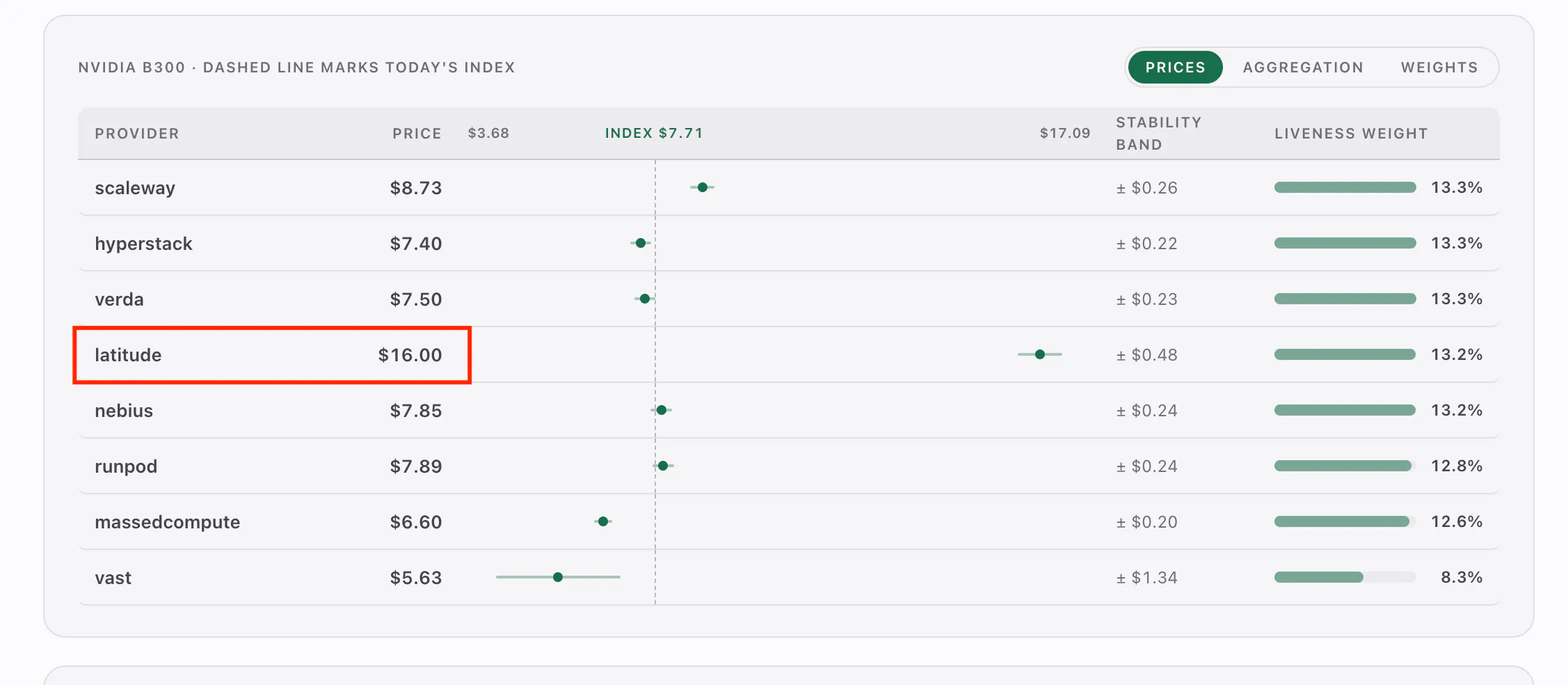
Hi Product Hunt, I'm Ray, cofounder of Computable.
What is the price of a GPU?
Nobody agrees. Every provider quotes a different number, and existing indexes are closed black boxes: a figure you are asked to trust without seeing the data, the method, or the code behind it. Despite being rented, resold, and financed at commodity scale, compute lacks the reference rate every mature commodity market has.
CGI is built to be that number, and to earn trust in the open rather than by authority. It is open data, open method, open code.
How it works: every 15 minutes we collect published on-demand rental rates from 28 providers. Each panel provider casts weighted votes at its price, and the index is an interquantile mean over those votes, not an average: only the central third of the vote mass is averaged. No small group of providers can drag the number from the tails.
The weights are systematically scored. Liveness weights measure whether a provider contributes new information to the price: a leave-one-out ridge regression scores whether each provider's recent moves anticipated the rest of the panel, and the weights recompute every observation. Every weight is floored and capped, and no weight requires a per-provider human decision.
The design rests on five properties: verifiable, reproducible, fault-tolerant, outlier-resistant, transparent. The data is verifiable, the method is transparent, the prints are reproducible via code, and the result is a robust price surviving data sources that disagree, err, or break.
Live today: H100, H200, B200, B300. The collector and the calculation are open source. Clone the repo and recompute any print since inception; you'll get the same number we published.
If you trade, rent, or finance compute, I'd love to hear what you want from a reference rate.