This product was not featured by Product Hunt yet. It will not be visible on their landing page and won't be ranked (cannot win product of the day regardless of upvotes).
AI Product Adoption Deck
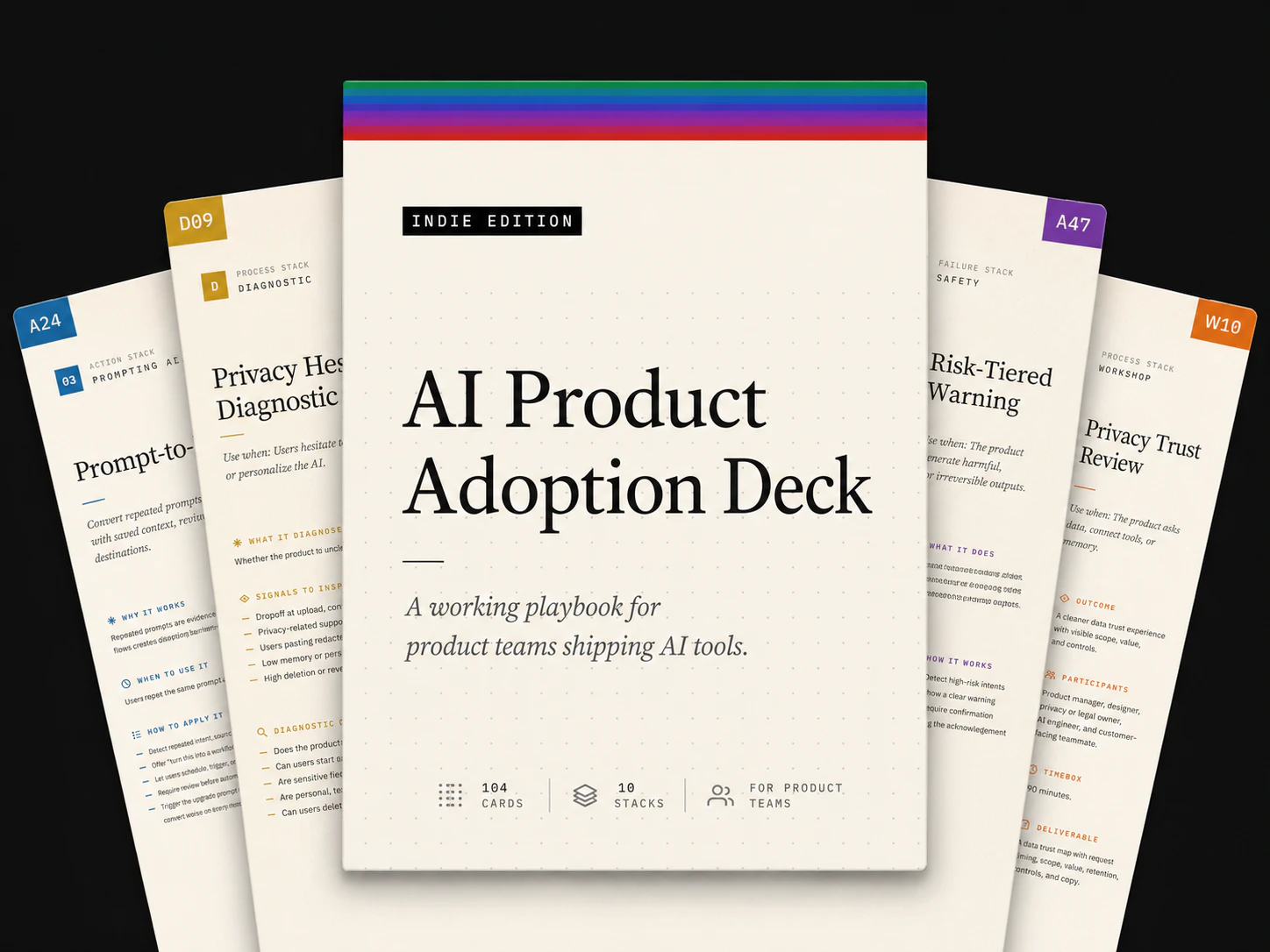
12 diagnostics, 80 action cards, 12 workshops - one workflow
Most AI products fail after the first use. Not because the model is bad — because the product decisions around it are. The AI Product Adoption Deck is 104 cards for the moments where adoption breaks: empty prompts, trust gaps, correction loops, agent anxiety, retention drop-off. Each card carries a diagnosis, an action, and a workshop. Drop the PDF into Claude or ChatGPT and get card-level answers on your own product. 124 pages. One-time purchase. Includes a SKILL.md file for any LLM.
Over the past 3 years I've shipped AI features that flopped. Sat in meetings where everyone knew something was off but nobody could put their finger on exactly what. Reached for advice and found blog posts that said things like "improve trust" or "reduce friction." Helpful. But what does that actually mean for the thing you're shipping right now, with a review on Friday and users quietly not coming back?
The deck started as a private doc — a running list of problems I kept hitting and watching other teams hit. Users who stared at the prompt box and left. Outputs that were impressive but that nobody acted on. Corrections that had to be made every single week. At some point the list was long enough that it needed some structure, and the card format grew out of that. I wanted something I could pick up at the problem I had today, not study cover to cover when I had a free week.
The result is the AI Product Adoption Deck which I'm proud to share with you knowing it brings real value. In fact, I'm so confident in the value proposition that I'm offering a 30 day no questions asked money back guarantee on your purchase if you don't see actual results.
The deck has already been privately battle tested with a small group product managers, engineers, consultants and AI teams working in fortune 500 companies - thank you for your invaluable feedback!
What about using it with your favourite model? At some point I realised the deck worked just as well inside a conversation as it did on paper. Drop it into LLM of your choice, describe what you're seeing, and boom - it reasons in the same structure — symptom, diagnosis, card. So I built a proper SKILL companion file for it. That's now part of what ships with the deck.
I hope it saves you the headaches it saved me. If you're not sure whether it's for you — there's a free triage companion at https://aiproduct.cards/triage. Describe what you're seeing and it'll point you to the right part of the deck. Takes two minutes. If you are not sure if it's worth it - start there!
I work with AI tools pretty much every day, and honestly most adoption problems don’t come from the model quality anymore. They come from people not trusting the output, not knowing what to do after the first result, or getting tired of correcting the same thing over and over. This deck feels like it was written by someone who has actually shipped AI features and dealt with those problems in production.
Hi! Congrats on the launch! A lot of AI advice falls apart the second you try applying it to a real product with real users. This feels different because it’s built around the exact moments where adoption starts slipping, usually slowly enough that teams miss it until retention tanks. The card format also makes way more sense than another 80-page “AI strategy” PDF nobody opens twice
This hits a problem almost every AI team runs into at some point: the model works, the demo looks good, then real users quietly stop using it. I like that this deck focuses on the messy parts people usually skip, like trust gaps, correction fatigue, and prompt paralysis, with actual actions instead of vague advice. The SKILL.md addition is smart too, because most teams are already troubleshooting product behavior inside ChatGPT or Claude anyway. Great work on putting structure around issues that are usually hard to explain in meetings.
About AI Product Adoption Deck on Product Hunt
“12 diagnostics, 80 action cards, 12 workshops - one workflow”
AI Product Adoption Deck was submitted on Product Hunt and earned 11 upvotes and 7 comments, placing #44 on the daily leaderboard. Most AI products fail after the first use. Not because the model is bad — because the product decisions around it are. The AI Product Adoption Deck is 104 cards for the moments where adoption breaks: empty prompts, trust gaps, correction loops, agent anxiety, retention drop-off. Each card carries a diagnosis, an action, and a workshop. Drop the PDF into Claude or ChatGPT and get card-level answers on your own product. 124 pages. One-time purchase. Includes a SKILL.md file for any LLM.
AI Product Adoption Deck was featured in User Experience (369.1k followers), Developer Tools (521.5k followers) and Artificial Intelligence (481.5k followers) on Product Hunt. Together, these topics include over 253.8k products, making this a competitive space to launch in.
Who hunted AI Product Adoption Deck?
AI Product Adoption Deck was hunted by Paulius Uza. A “hunter” on Product Hunt is the community member who submits a product to the platform — uploading the images, the link, and tagging the makers behind it. Hunters typically write the first comment explaining why a product is worth attention, and their followers are notified the moment they post. Around 79% of featured launches on Product Hunt are self-hunted by their makers, but a well-known hunter still acts as a signal of quality to the rest of the community. See the full all-time top hunters leaderboard to discover who is shaping the Product Hunt ecosystem.
Want to see how AI Product Adoption Deck stacked up against nearby launches in real time? Check out the live launch dashboard for upvote speed charts, proximity comparisons, and more analytics.

 Paulius Uza
Hey everyone — Paulius here.
Over the past 3 years I've shipped AI features that flopped. Sat in meetings where everyone knew something was off but nobody could put their finger on exactly what. Reached for advice and found blog posts that said things like "improve trust" or "reduce friction." Helpful. But what does that actually mean for the thing you're shipping right now, with a review on Friday and users quietly not coming back?
The deck started as a private doc — a running list of problems I kept hitting and watching other teams hit. Users who stared at the prompt box and left. Outputs that were impressive but that nobody acted on. Corrections that had to be made every single week. At some point the list was long enough that it needed some structure, and the card format grew out of that. I wanted something I could pick up at the problem I had today, not study cover to cover when I had a free week.
The result is the AI Product Adoption Deck which I'm proud to share with you knowing it brings real value. In fact, I'm so confident in the value proposition that I'm offering a 30 day no questions asked money back guarantee on your purchase if you don't see actual results.
The deck has already been privately battle tested with a small group product managers, engineers, consultants and AI teams working in fortune 500 companies - thank you for your invaluable feedback!
What about using it with your favourite model? At some point I realised the deck worked just as well inside a conversation as it did on paper. Drop it into LLM of your choice, describe what you're seeing, and boom - it reasons in the same structure — symptom, diagnosis, card. So I built a proper SKILL companion file for it. That's now part of what ships with the deck.
I hope it saves you the headaches it saved me. If you're not sure whether it's for you — there's a free triage companion at https://aiproduct.cards/triage. Describe what you're seeing and it'll point you to the right part of the deck. Takes two minutes. If you are not sure if it's worth it - start there!