This product was not featured by Product Hunt yet. It will not be visible on their landing page and won't be ranked (cannot win product of the day regardless of upvotes).
Product upvotes vs the next 3
Waiting for data. Loading
Product comments vs the next 3
Waiting for data. Loading
Product upvote speed vs the next 3
Waiting for data. Loading
Product upvotes and comments
Waiting for data. Loading
Product vs the next 3
Loading
Vacuum Lifters
Learn how vacuum lifters improve safety and efficiency
A practical guide to vacuum lifters for sheet metal handling how they work, key benefits, typical capacities, and tips for choosing the right system.
Vacuum Lifter: Efficient Material Handling for Modern Industries
Material handling is an important part of manufacturing, fabrication, construction, and warehouse operations. Moving heavy, large, or delicate materials manually can take considerable time and may create unnecessary safety risks. A vacuum lifter provides a practical solution by using vacuum suction to grip and move suitable materials with less manual effort.
Today, vacuum lifting equipment is used for handling sheet metal, glass, slabs, billets, panels, and other rigid materials. Depending on the application, different types of lifting equipment can be selected to match the weight, dimensions, surface condition, and handling requirements of the material.
What Is a Vacuum Lifter?
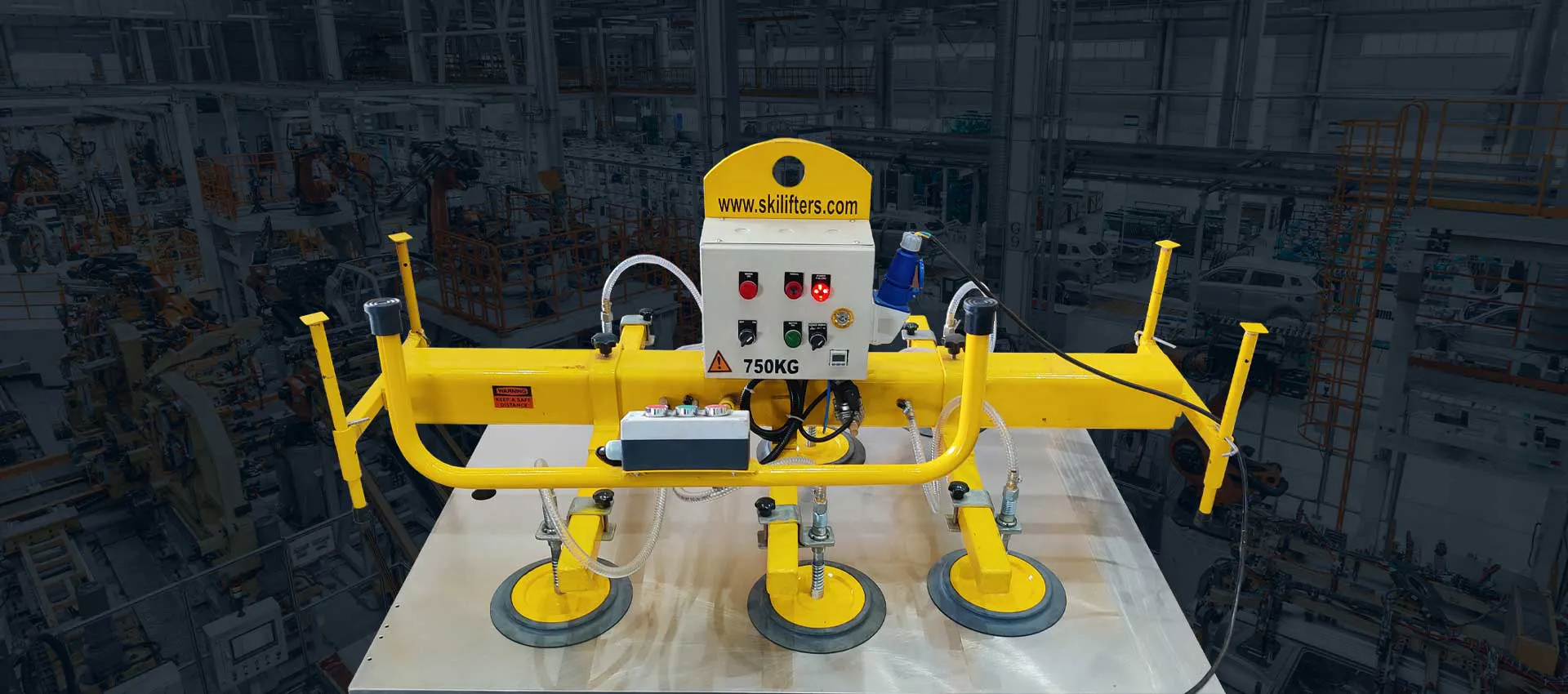
A vacuum lifter is a material-handling device that uses suction to securely grip a workpiece. Vacuum is generated through a pump or suitable vacuum system, creating a pressure difference between the suction pad and the surface of the material.
Once the required vacuum level is achieved, the material can be lifted and moved using an appropriate lifting arrangement, such as an overhead crane.
Unlike conventional mechanical lifting methods, vacuum handling allows suitable materials to be gripped without hooks, chains, or clamps directly contacting the workpiece. This can be particularly useful when handling finished or sensitive surfaces.
Vacuum lifters are available in different configurations and lifting capacities. The correct equipment depends on the type of material being handled and the requirements of the particular application.
How Does a Vacuum Lifting System Work?
The working principle of vacuum lifting is straightforward. Suction pads are positioned against the surface of the material, and the vacuum system removes air from the space between the pad and workpiece.
This creates suction that holds the load against the lifting device. After checking that the material is securely held, the operator can lift and move it to the required location.
A typical operation includes:
1. Positioning the vacuum pads correctly.
2. Activating the vacuum system.
3. Establishing sufficient suction.
4. Checking the vacuum and load security.
5. Lifting the material.
6. Moving it to the desired location.
7. Lowering and releasing the material safely.
Proper positioning of suction cups is important because the load capacity depends not only on its weight but also on its surface, dimensions, material characteristics, and lifting orientation.
Vacuum Lifter for Sheet Metal Handling
One of the most common industrial applications is sheet metal handling. Large metal sheets can be difficult to move manually because of their weight and dimensions.
A vacuum lifting system can help transfer sheets from storage racks or stacks to processing machinery. It can also reduce the amount of physical effort required during repetitive material-handling operations.
Vacuum lifters equipment may be suitable for materials such as stainless steel and other rigid ferrous or non-ferrous sheets, provided the surface characteristics are compatible with the vacuum system.
For laser-cut sheets, coated surfaces, or sheets with apertures, the suction-pad arrangement needs to be selected according to the application.
Industrial Vacuum Lifter for Manufacturing
An Industrial Vacuum Lifter is designed for demanding material-handling environments where equipment may be used regularly throughout the production process.
Manufacturing facilities often need to move materials between storage areas, machines, workstations, and assembly sections. Repeated manual handling can slow down production and increase physical strain on workers.
An industrial vacuum lifting system can make these operations more convenient by allowing suitable workpieces to be picked up, moved, and positioned using controlled lifting equipment.
Depending on the application, industrial vacuum lifting systems can be configured with multiple suction cups and different lifting capacities.
Slab Lifter for Large and Rigid Materials
A Slab Lifter is another type of specialized lifting solution used for handling large slabs and rigid materials.
Large slabs can be difficult to manoeuvre because of their size and weight. A suitable vacuum-based slab handling system can provide controlled gripping over the surface and help operators move the material more efficiently.
The appropriate lifting configuration depends on the slab's dimensions, weight, surface characteristics, and the direction in which it needs to be handled.
For businesses regularly working with large rigid materials, selecting equipment specifically suited to slab handling can help improve both workflow and operator convenience.
Billet Lifter for Industrial Material Handling
Billets and other heavy metal products require suitable equipment for safe movement within manufacturing and processing facilities.
A Billet Lifter can be used as a specialized material-handling solution where the shape, weight, and surface characteristics of the billet are compatible with the lifting method.
In industrial environments, efficient movement of raw materials is important because billets may need to be transferred between storage, processing, heating, and production areas.
When selecting lifting equipment for billets, factors such as weight, dimensions, surface condition, lifting orientation, and the required lifting frequency should be evaluated carefully.
Glass Vacuum Lifter for Delicate Surfaces
Glass requires careful handling because it can be heavy, large, and vulnerable to scratches, cracks, or breakage.
A Glass Vacuum Lifter is designed specifically for applications where glass panels or similar smooth materials need to be lifted and positioned.
Vacuum suction can provide a controlled method of gripping the glass without requiring traditional mechanical clamps to hold the edges. This can be useful when moving glass panels during installation, manufacturing, storage, or transportation.
However, the equipment must always be selected according to the glass dimensions, weight, surface condition, and manufacturer's specified operating limits.
About Vacuum Lifters on Product Hunt
“Learn how vacuum lifters improve safety and efficiency ”
Vacuum Lifters was submitted on Product Hunt and earned 0 upvotes and 1 comments, placing #12 on the daily leaderboard. A practical guide to vacuum lifters for sheet metal handling how they work, key benefits, typical capacities, and tips for choosing the right system.
On the analytics side, Vacuum Lifters competes within Construction — topics that collectively have 1.5k followers on Product Hunt. The dashboard above tracks how Vacuum Lifters performed against the three products that launched closest to it on the same day.
Who hunted Vacuum Lifters?
Vacuum Lifters was hunted by Shantanu Web link. A “hunter” on Product Hunt is the community member who submits a product to the platform — uploading the images, the link, and tagging the makers behind it. Hunters typically write the first comment explaining why a product is worth attention, and their followers are notified the moment they post. Around 79% of featured launches on Product Hunt are self-hunted by their makers, but a well-known hunter still acts as a signal of quality to the rest of the community. See the full all-time top hunters leaderboard to discover who is shaping the Product Hunt ecosystem.
For a complete overview of Vacuum Lifters including community comment highlights and product details, visit the product overview.

 Shantanu Web link