This product was not featured by Product Hunt yet. It will not be visible on their landing page and won't be ranked (cannot win product of the day regardless of upvotes).
Product upvotes vs the next 3
Waiting for data. Loading
Product comments vs the next 3
Waiting for data. Loading
Product upvote speed vs the next 3
Waiting for data. Loading
Product upvotes and comments
Waiting for data. Loading
Product vs the next 3
Loading
The Euro System as a (19,9,3,3)-System
Open-source framework for cryptography & data analysis
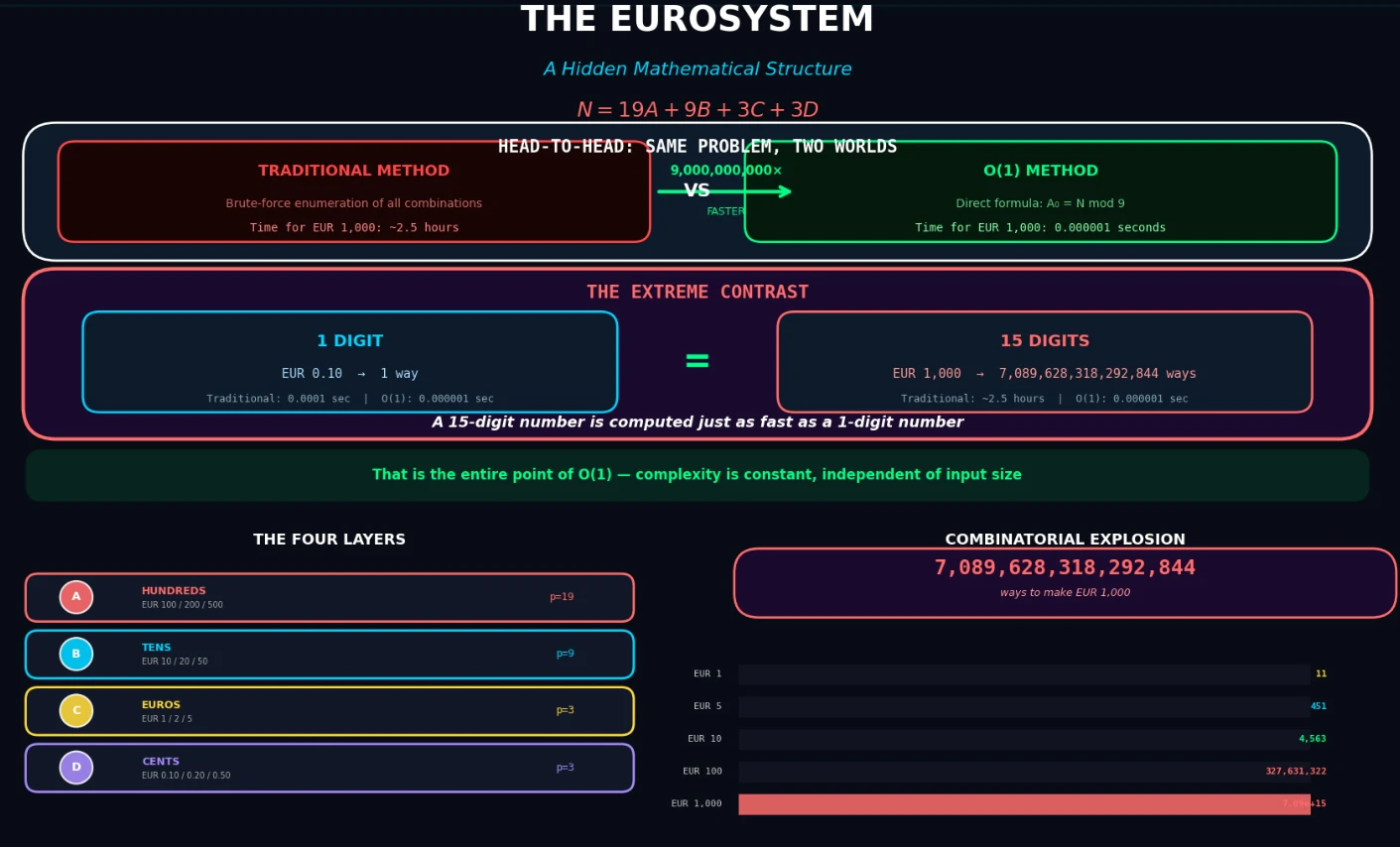
The entire system can be written as a single formula: N = 19A + 9B + 3C + 3D where A, B, C, D count the denominations in each layer. The coefficients 19, 9, 3, 3 are not arbitrary — they satisfy 19 ≡ 1 (mod 9), and each divides the next. For any amount N (in units of €0.10), the minimal starting value is always: A₀ = N mod 9 Computed in O(1).
I started this project from a simple observation: numbers that look random often hide deep structure. The 19-9 system began as a personal exploration — mapping how integers decompose under modular constraints — and evolved into a complete framework with direct applications in cryptographic key generation and number-theoretic analysis.
What began on paper (and a weak phone running Python scripts) is now a formalized system with published proofs on Zenodo and an open-source implementation on GitHub. The core insight: certain integer representations act as "fixed points" where linear and quadratic growth converge — a property with implications for efficient key derivation and pattern recognition in large datasets.
I'm now looking to scale this from a solo research project into a deployable tool. If you're building in fintech, cryptography, or data infrastructure — or if you see structural beauty in numbers the way I do — I'd love to hear from you. Open to feedback, collaboration, and conversations with investors who understand that deep structure, not hype, is what lasts.
El issaoui, B. (2026). The Euro System as a (19,9,3,3)-Representation System. Zenodo. https://doi.org/10.5281/zenodo.2...
el Issaoui, B. (2026). N = 25A + 12B | 25 = 1 (mod 12) | 🕐. Zenodo. https://doi.org/10.5281/zenodo.2...
el Issaoui, B. (2026). p ≡ 1 (mod q). Zenodo. https://doi.org/10.5281/zenodo.2...
About The Euro System as a (19,9,3,3)-System on Product Hunt
“Open-source framework for cryptography & data analysis ”
The Euro System as a (19,9,3,3)-System was submitted on Product Hunt and earned 0 upvotes and 1 comments, placing #38 on the daily leaderboard. The entire system can be written as a single formula: N = 19A + 9B + 3C + 3D where A, B, C, D count the denominations in each layer. The coefficients 19, 9, 3, 3 are not arbitrary — they satisfy 19 ≡ 1 (mod 9), and each divides the next. For any amount N (in units of €0.10), the minimal starting value is always: A₀ = N mod 9 Computed in O(1).
On the analytics side, The Euro System as a (19,9,3,3)-System competes within Open Source, Fintech, Developer Tools and GitHub — topics that collectively have 679.5k followers on Product Hunt. The dashboard above tracks how The Euro System as a (19,9,3,3)-System performed against the three products that launched closest to it on the same day.
Who hunted The Euro System as a (19,9,3,3)-System?
The Euro System as a (19,9,3,3)-System was hunted by Bilal el Issaoui . A “hunter” on Product Hunt is the community member who submits a product to the platform — uploading the images, the link, and tagging the makers behind it. Hunters typically write the first comment explaining why a product is worth attention, and their followers are notified the moment they post. Around 79% of featured launches on Product Hunt are self-hunted by their makers, but a well-known hunter still acts as a signal of quality to the rest of the community. See the full all-time top hunters leaderboard to discover who is shaping the Product Hunt ecosystem.
For a complete overview of The Euro System as a (19,9,3,3)-System including community comment highlights and product details, visit the product overview.

 Bilal el Issaoui