This product was not featured by Product Hunt yet. It will not be visible on their landing page and won't be ranked (cannot win product of the day regardless of upvotes).
Product upvotes vs the next 3
Waiting for data. Loading
Product comments vs the next 3
Waiting for data. Loading
Product upvote speed vs the next 3
Waiting for data. Loading
Product upvotes and comments
Waiting for data. Loading
Product vs the next 3
Loading
SonicForge
A 16-channel tone generator with a live 3D spectrogram
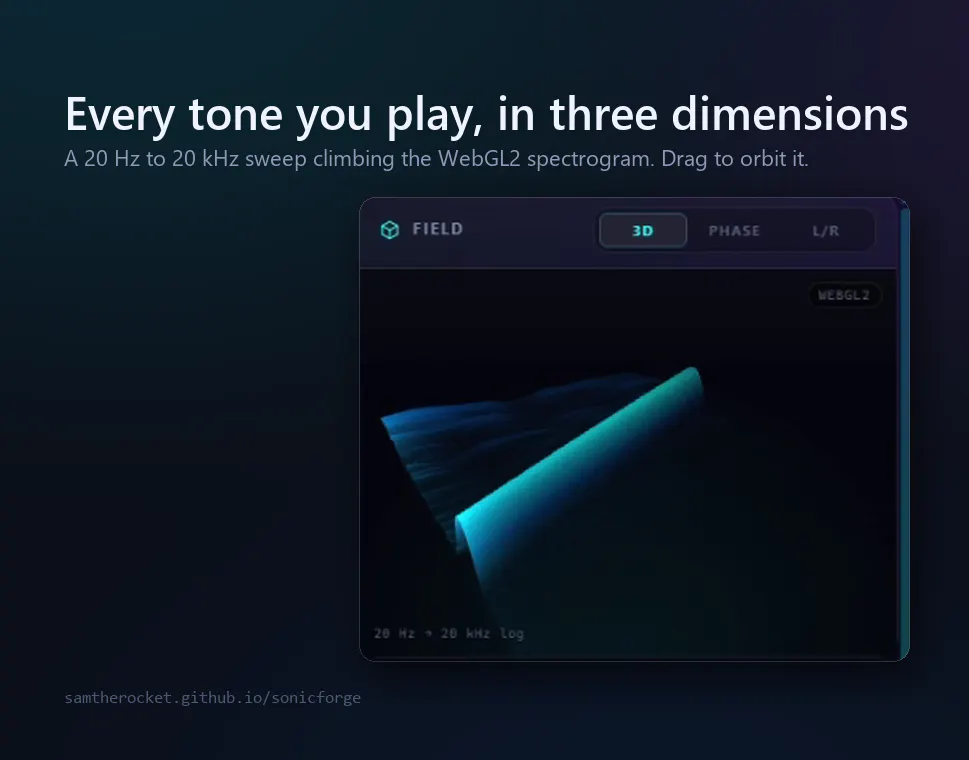
Sixteen tone channels with real phase control, seven noise colours, microphone room calibration, a scripting terminal and a WebGL 3D spectrogram. Also speaker water eject and headphone burn-in. Client-side only: nothing uploaded, works offline.
Hi Product Hunt
I built SonicForge because every online tone generator is a slider and a play button, and I kept needing more than that. This came out of a combustion-acoustics experiment where the excitation had to be controlled: known, repeatable, comparable between runs. No tool I tried offered phase at all, and each one named its levels differently.
The part I would point at first: two channels 180 degrees apart cancel to exact silence. That sounds obvious, but OscillatorNode in the Web Audio API has no phase parameter - you genuinely cannot start two oscillators at a chosen offset. SonicForge builds each waveform from its Fourier coefficients and rotates every harmonic, so the phase is baked into the wave table, and every channel is locked to the audio clock. The test suite asserts the residual is 0.00e+0.
What is inside: 16 tone channels with level in dBFS and phase in degrees, seven noise colours, microphone room calibration that measures round-trip latency first, a scripting terminal that runs on the audio clock, a WebGL2 3D spectrogram, and hardware presets like speaker water eject and headphone burn-in.
Things I decided not to do:
- No Three.js. The 3D spectrogram is raw WebGL2, because a CDN dependency would break the offline guarantee.
- No QR library. The encoder is written from ISO/IEC 18004.
- No backend, no analytics, no account. The microphone opens only during a calibration measurement and is released in a finally block.
There are 120 assertions plus a 70-check application self-test, and nothing is mocked: the noise tests measure the real spectrum of a generated buffer, and the integration tests render audio through OfflineAudioContext and check the samples. Pink noise measures -3.05 dB/octave against a nominal -3.
MIT licensed. Happy to answer anything about the DSP.
About SonicForge on Product Hunt
“A 16-channel tone generator with a live 3D spectrogram”
SonicForge was submitted on Product Hunt and earned 3 upvotes and 1 comments, placing #84 on the daily leaderboard. Sixteen tone channels with real phase control, seven noise colours, microphone room calibration, a scripting terminal and a WebGL 3D spectrogram. Also speaker water eject and headphone burn-in. Client-side only: nothing uploaded, works offline.
On the analytics side, SonicForge competes within Web App, Open Source, GitHub and Audio — topics that collectively have 236.9k followers on Product Hunt. The dashboard above tracks how SonicForge performed against the three products that launched closest to it on the same day.
Who hunted SonicForge?
SonicForge was hunted by Sambit Supriya Dash. A “hunter” on Product Hunt is the community member who submits a product to the platform — uploading the images, the link, and tagging the makers behind it. Hunters typically write the first comment explaining why a product is worth attention, and their followers are notified the moment they post. Around 79% of featured launches on Product Hunt are self-hunted by their makers, but a well-known hunter still acts as a signal of quality to the rest of the community. See the full all-time top hunters leaderboard to discover who is shaping the Product Hunt ecosystem.
For a complete overview of SonicForge including community comment highlights and product details, visit the product overview.

 Sambit Supriya Dash