This product was not featured by Product Hunt yet. It will not be visible on their landing page and won't be ranked (cannot win product of the day regardless of upvotes).
Product upvotes vs the next 3
Waiting for data. Loading
Product comments vs the next 3
Waiting for data. Loading
Product upvote speed vs the next 3
Waiting for data. Loading
Product upvotes and comments
Waiting for data. Loading
Product vs the next 3
Loading
PAIDEIA
Turn course PDFs into a local exam-prep brain
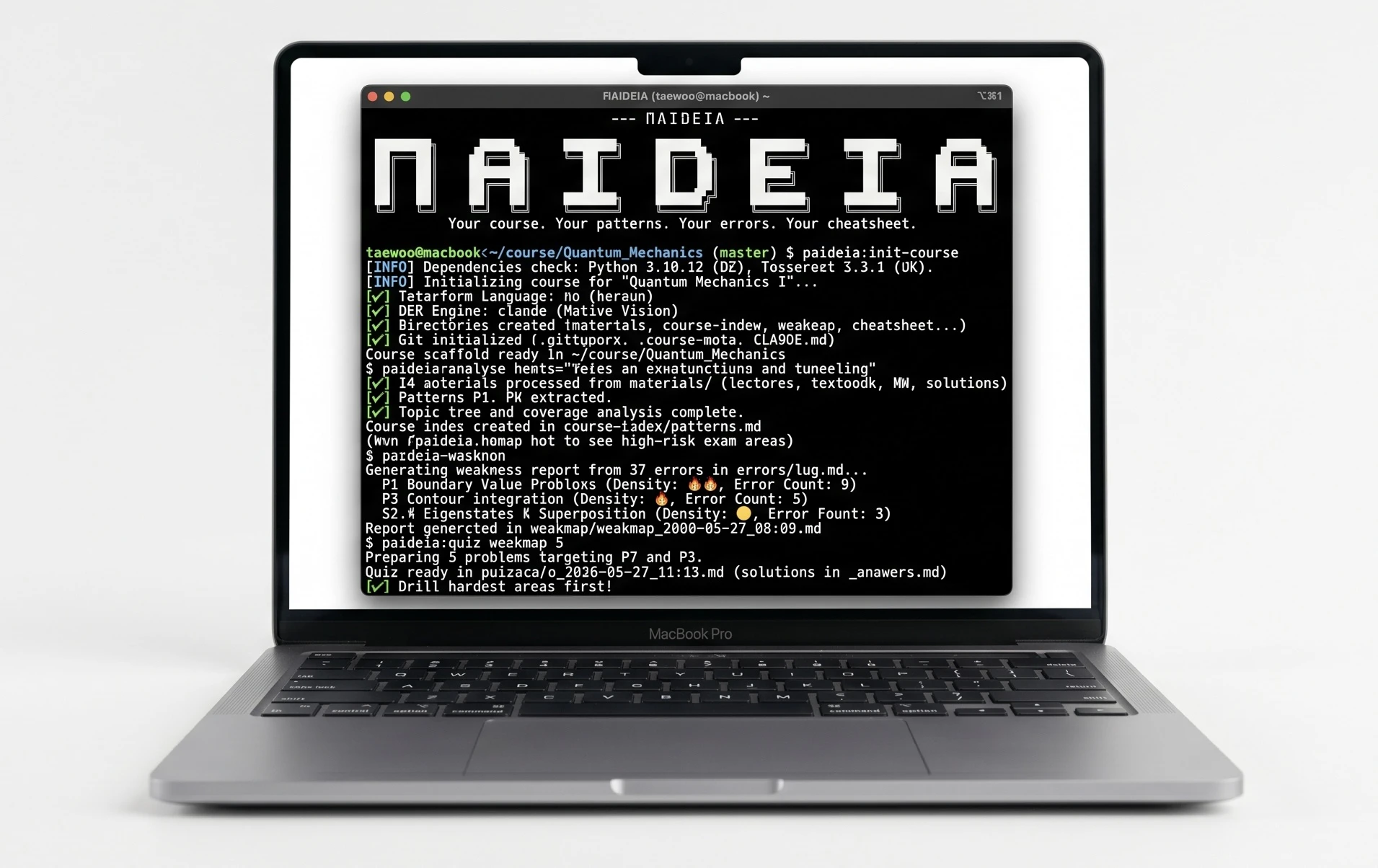
PAIDEIA is a local-first Claude Code plugin for students who study from messy course PDFs, homework, solutions, and handwritten mistakes. Instead of teaching an average syllabus, it builds your course-specific exam graph: PDF-to-Markdown ingestion, solution pattern extraction, homework-density weighting, OCR grading, weakmaps, drills, mock exams, and cheat sheets. Every artifact stays on disk as editable Markdown.
I’m Taewoo, a physics and mathematics undergraduate at KAIST. I built PAIDEIA after seeing students, including myself, rely on the same pattern before exams: upload a pile of lecture PDFs into a chatbot, ask for summaries, then lose most of the context when the session ends.
Quick summaries are useful, but they miss the signals that actually matter in a real course:
- what your professor repeatedly emphasizes - which homework patterns keep appearing - where you personally make mistakes - which topics are likely to show up on the exam
PAIDEIA is my attempt to make that study state persistent.
It is a Claude Code plugin that turns your course PDFs, homework, solutions, and handwritten scanned answers into a local exam-prep knowledge base.
It can convert PDFs into Markdown, extract recurring solution patterns, rank topics by homework density, generate drills and mock exams, OCR-grade handwritten answers, and build weakmaps and cheat sheets from your own mistakes.
The important part: everything stays on disk as editable Markdown. You can open it in Obsidian, edit it manually, commit it, or keep using it even if the model changes later.
I added real Claude Code terminal demo videos to the README so the workflow is easier to judge.
I’d love feedback from students, educators, Claude Code users, and anyone interested in local-first AI tools.
About PAIDEIA on Product Hunt
“Turn course PDFs into a local exam-prep brain”
PAIDEIA was submitted on Product Hunt and earned 3 upvotes and 1 comments, placing #148 on the daily leaderboard. PAIDEIA is a local-first Claude Code plugin for students who study from messy course PDFs, homework, solutions, and handwritten mistakes. Instead of teaching an average syllabus, it builds your course-specific exam graph: PDF-to-Markdown ingestion, solution pattern extraction, homework-density weighting, OCR grading, weakmaps, drills, mock exams, and cheat sheets. Every artifact stays on disk as editable Markdown.
On the analytics side, PAIDEIA competes within Education, Developer Tools, Artificial Intelligence and GitHub — topics that collectively have 1.1M followers on Product Hunt. The dashboard above tracks how PAIDEIA performed against the three products that launched closest to it on the same day.
Who hunted PAIDEIA?
PAIDEIA was hunted by 박태우. A “hunter” on Product Hunt is the community member who submits a product to the platform — uploading the images, the link, and tagging the makers behind it. Hunters typically write the first comment explaining why a product is worth attention, and their followers are notified the moment they post. Around 79% of featured launches on Product Hunt are self-hunted by their makers, but a well-known hunter still acts as a signal of quality to the rest of the community. See the full all-time top hunters leaderboard to discover who is shaping the Product Hunt ecosystem.
For a complete overview of PAIDEIA including community comment highlights and product details, visit the product overview.

 박태우
박태우
Hey Product Hunt!
I’m Taewoo, a physics and mathematics undergraduate at KAIST. I built PAIDEIA after seeing students, including myself, rely on the same pattern before exams: upload a pile of lecture PDFs into a chatbot, ask for summaries, then lose most of the context when the session ends.
Quick summaries are useful, but they miss the signals that actually matter in a real course:
- what your professor repeatedly emphasizes
- which homework patterns keep appearing
- where you personally make mistakes
- which topics are likely to show up on the exam
PAIDEIA is my attempt to make that study state persistent.
It is a Claude Code plugin that turns your course PDFs, homework, solutions, and handwritten scanned answers into a local exam-prep knowledge base.
The workflow is:
ingest → analyze → drill → grade → weakmap → cheatsheet
It can convert PDFs into Markdown, extract recurring solution patterns, rank topics by homework density, generate drills and mock exams, OCR-grade handwritten answers, and build weakmaps and cheat sheets from your own mistakes.
The important part: everything stays on disk as editable Markdown. You can open it in Obsidian, edit it manually, commit it, or keep using it even if the model changes later.
I added real Claude Code terminal demo videos to the README so the workflow is easier to judge.
I’d love feedback from students, educators, Claude Code users, and anyone interested in local-first AI tools.