This product was not featured by Product Hunt yet. It will not be visible on their landing page and won't be ranked (cannot win product of the day regardless of upvotes).
Product upvotes vs the next 3
Waiting for data. Loading
Product comments vs the next 3
Waiting for data. Loading
Product upvote speed vs the next 3
Waiting for data. Loading
Product upvotes and comments
Waiting for data. Loading
Product vs the next 3
Loading
IZIOS
Find lab-grown diamonds with search that makes sense
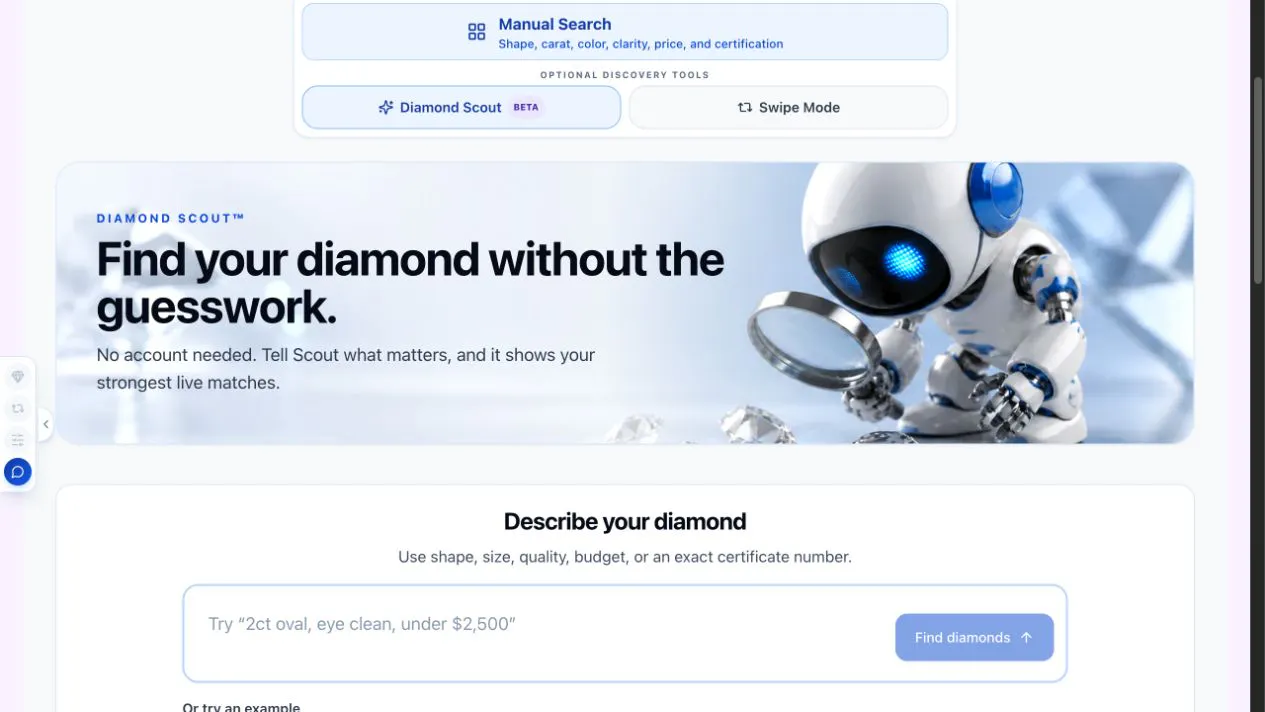
Search lab-grown diamonds with manual filters or describe what you want with Diamond Scout, currently in beta. Compare listing and report details, explore diamonds in your price range with the free calculator, and use free education guides and metals widgets.
Hi, I’m Jeff. I built a diamond marketplace almost by accident. I was trying to fix search for Sugarberry Memorials, the memorial jewelry business my wife, Kayce Jones, and I run together. Supplier CSVs were frustrating, and our customers wanted to search for diamonds themselves.
In 2024, I paid an outside development agency thousands of dollars for a diamond search system. They promised three weeks and delivered four months later with a cumbersome Shopify-connected version. The feed was unreliable and it did not meet our needs, so I decided to build it myself.
I started the Replit version in December 2024. It was a vibe-coded beginning, and I built it in public. The early stack used TypeScript, Express, PostgreSQL, and Drizzle, with CSV/XLSX and FTP imports. The hard part quickly became changing inventory: sold stones, duplicates, inconsistent feeds, and records representing multiple stones.
Supplier files were roughly 600–800 MB per import. Reconciling them required heavy database reads and writes even after major optimizations. I understood my included Replit/Neon database-ingress allowance then to be 10 GB a month—one reason I needed to rethink the infrastructure.
The first commerce handoff used WooCommerce to create a product for checkout and return order details to IZIOS. Supplier checks, holds, cart data, product creation, payment, and order return all had to stay coordinated. I moved toward a custom cart and direct Stripe integration. In December 2025, I described the flow I was designing: availability check, authorization, supplier hold, then capture. A data-handoff bug in the first real Stripe and Affirm orders left order processing with part of the expected payload; I flattened the metadata and added validation flags.
Today, the custom backend is a monolith I maintain alone. Imports, identity, availability, API, storefront data, cart, provider holds, Stripe events, orders, feed status, job failures, and order state meet across boundaries. Replit was still app/staging infrastructure in April 2026; by June I had moved database and compute to infrastructure I controlled. Many hundreds of hours have gone into designing and revising it. Yay for me :-p
My first independent host was a $300 2013 Mac Pro with twelve cores and 64 GB of RAM, connected through Cloudflare Tunnel. It ran the platform until early October 2026 with no downtime in my experience.
Questions about diamonds come directly to me; Kayce handles questions about memorial jewelry. AI helps with code and research, while we handle customer conversations ourselves. Feedback is welcome from people dealing with changing catalogs, checkout handoffs, or the gap between a prototype and a system that has to operate.
About IZIOS on Product Hunt
“Find lab-grown diamonds with search that makes sense”
IZIOS was submitted on Product Hunt and earned 0 upvotes and 1 comments, placing #392 on the daily leaderboard. Search lab-grown diamonds with manual filters or describe what you want with Diamond Scout, currently in beta. Compare listing and report details, explore diamonds in your price range with the free calculator, and use free education guides and metals widgets.
On the analytics side, IZIOS competes within Artificial Intelligence, E-Commerce and Search — topics that collectively have 541.7k followers on Product Hunt. The dashboard above tracks how IZIOS performed against the three products that launched closest to it on the same day.
Who hunted IZIOS?
IZIOS was hunted by Jeffrey Jones. A “hunter” on Product Hunt is the community member who submits a product to the platform — uploading the images, the link, and tagging the makers behind it. Hunters typically write the first comment explaining why a product is worth attention, and their followers are notified the moment they post. Around 79% of featured launches on Product Hunt are self-hunted by their makers, but a well-known hunter still acts as a signal of quality to the rest of the community. See the full all-time top hunters leaderboard to discover who is shaping the Product Hunt ecosystem.
For a complete overview of IZIOS including community comment highlights and product details, visit the product overview.

 Jeffrey Jones

Hi, I’m Jeff. I built a diamond marketplace almost by accident. I was trying to fix search for Sugarberry Memorials, the memorial jewelry business my wife, Kayce Jones, and I run together. Supplier CSVs were frustrating, and our customers wanted to search for diamonds themselves.
In 2024, I paid an outside development agency thousands of dollars for a diamond search system. They promised three weeks and delivered four months later with a cumbersome Shopify-connected version. The feed was unreliable and it did not meet our needs, so I decided to build it myself.
I started the Replit version in December 2024. It was a vibe-coded beginning, and I built it in public. The early stack used TypeScript, Express, PostgreSQL, and Drizzle, with CSV/XLSX and FTP imports. The hard part quickly became changing inventory: sold stones, duplicates, inconsistent feeds, and records representing multiple stones.
Supplier files were roughly 600–800 MB per import. Reconciling them required heavy database reads and writes even after major optimizations. I understood my included Replit/Neon database-ingress allowance then to be 10 GB a month—one reason I needed to rethink the infrastructure.
The first commerce handoff used WooCommerce to create a product for checkout and return order details to IZIOS. Supplier checks, holds, cart data, product creation, payment, and order return all had to stay coordinated. I moved toward a custom cart and direct Stripe integration. In December 2025, I described the flow I was designing: availability check, authorization, supplier hold, then capture. A data-handoff bug in the first real Stripe and Affirm orders left order processing with part of the expected payload; I flattened the metadata and added validation flags.
Today, the custom backend is a monolith I maintain alone. Imports, identity, availability, API, storefront data, cart, provider holds, Stripe events, orders, feed status, job failures, and order state meet across boundaries. Replit was still app/staging infrastructure in April 2026; by June I had moved database and compute to infrastructure I controlled. Many hundreds of hours have gone into designing and revising it. Yay for me :-p
My first independent host was a $300 2013 Mac Pro with twelve cores and 64 GB of RAM, connected through Cloudflare Tunnel. It ran the platform until early October 2026 with no downtime in my experience.
I also built an API so we can offer diamonds inside Sugarberry’s experience, while IZIOS is available to anyone who wants to search. Try manual diamond search or Diamond Scout, currently in beta. The free Diamond Price Calculator and free metals widgets are also available.
Questions about diamonds come directly to me; Kayce handles questions about memorial jewelry. AI helps with code and research, while we handle customer conversations ourselves. Feedback is welcome from people dealing with changing catalogs, checkout handoffs, or the gap between a prototype and a system that has to operate.