This product was not featured by Product Hunt yet. It will not be visible on their landing page and won't be ranked (cannot win product of the day regardless of upvotes).
Product upvotes vs the next 3
Waiting for data. Loading
Product comments vs the next 3
Waiting for data. Loading
Product upvote speed vs the next 3
Waiting for data. Loading
Product upvotes and comments
Waiting for data. Loading
Product vs the next 3
Loading
HearthNet
community AI mesh that works offline
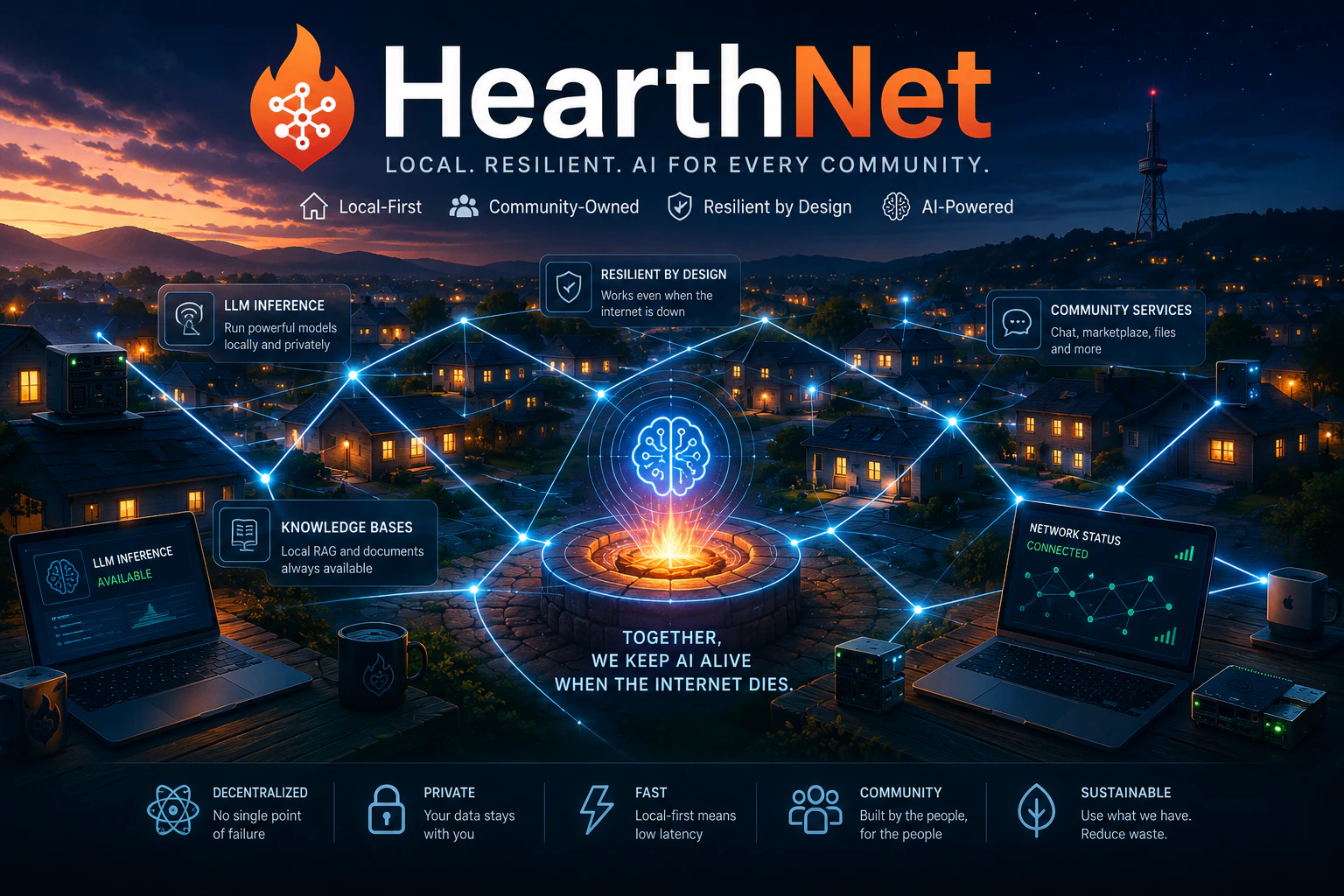
Imagine the internet cable in your neighbourhood gets cut. Right now, that means no Google, no ChatGPT, no maps, no marketplace, no messaging. The cloud goes silent. HearthNet changes that. It's a local AI mesh that turns local devices in your neighbourhood — your gaming PC, your neighbour's old laptop, the Pi in someone's attic — into a shared, resilient AI cooperative. The answer is generated locally, three streets away. The cloud owns AI today. Communities will own it tomorrow.
0. The 2-minute pitch
Imagine the internet cable in your neighbourhood gets cut. Right now, that means no Google, no ChatGPT, no maps, no marketplace, no messaging. The cloud goes silent and you're alone with whatever's on your phone.
HearthNet changes that. It's a local AI mesh that turns the computers already in your neighbourhood — your gaming PC, your neighbour's old laptop, the Raspberry Pi in someone's attic — into a shared, resilient AI cooperative. Discovery is automatic. You don't configure anything. You open the app, it finds the nodes nearby, you ask a question. The answer is generated locally, on someone's GPU, three streets away.
When the internet is up, it federates with the cloud. When the internet drops, you don't even notice — the system switches to local mode, and the AI, the file library, the neighbourhood marketplace, and the local chat all keep working.
The architecture is built around one idea: a capability bus. Every node announces what it can do — run inference, store files, hold a vector index, relay messages. Every request finds the best node for the job. New service? Plug it in. New transport — LoRa, mesh radio? Plug it in below. The kernel stays small. The system gets stronger as the community grows.
For the hackathon, we demo the full loop live: a mesh of three real nodes on stage, LLM routing across them, RAG over an emergency PDF library, a community marketplace, and a clean fail-over when we unplug the WAN cable. Phase 2 brings real-distance transports and federated learning across communities. Phase 3 explores actual distributed inference.
The cloud owns AI today. HearthNet is the bet that communities will own it tomorrow.
1. Executive summary
HearthNet is a peer-to-peer software stack that lets a small number of devices on the same network (or, later, the same neighbourhood) discover each other, share compute and storage, and provide AI services to each other and to thin clients. The system is designed to keep working when the wider internet does not.
The technical core is a capability bus: a small, transport-agnostic routing layer that knows which nodes can fulfil which request, picks the best one, enforces a schema contract, handles backpressure, and reports health. Everything else — the LLM, the RAG, the file share, the marketplace, the UI — is a plug-in.
The MVP is a single-binary Python application that runs on Linux, macOS, and Windows, exposes a Gradio web UI on localhost:7860, joins a LAN mesh via mDNS, and uses llama.cpp or Ollama for inference. The demo runs on three machines: a workstation with a GPU, a laptop, and a Raspberry Pi acting as a thin client.
Post-hackathon the project has three viable commercial paths: retail-continuity offering, a municipal/civil-defence pilot in NRW, and a "HearthNet-in-a-Box" appliance for community groups.
2. Vision & positioning
2.1 The problem we're solving
Modern households are now utterly dependent on cloud AI. The same is increasingly true for businesses, schools, and emergency services. When the cable, the DSL line, or the cloud provider drops, productivity stops. Communities have no fallback.
At the same time, the average household has multiple idle computers — a gaming PC at 5% utilisation, a workstation that runs Slack, an old laptop in a drawer. Aggregated across a neighbourhood, this is a non-trivial amount of compute. None of it cooperates today.
2.2 What HearthNet is
A peer-to-peer, local-first AI fabric that:
Discovers nodes automatically on the local network
Routes AI/data requests to the best available node
Tolerates partitions, internet outages, and node churn
Federates with the cloud when available, falls back gracefully when not
Is owned by its participants — no central operator, no telemetry pipeline to a vendor
.....
https://huggingface.co/spaces/bu...
About HearthNet on Product Hunt
“community AI mesh that works offline”
HearthNet was submitted on Product Hunt and earned 0 upvotes and 1 comments, placing #81 on the daily leaderboard. Imagine the internet cable in your neighbourhood gets cut. Right now, that means no Google, no ChatGPT, no maps, no marketplace, no messaging. The cloud goes silent. HearthNet changes that. It's a local AI mesh that turns local devices in your neighbourhood — your gaming PC, your neighbour's old laptop, the Pi in someone's attic — into a shared, resilient AI cooperative. The answer is generated locally, three streets away. The cloud owns AI today. Communities will own it tomorrow.
On the analytics side, HearthNet competes within Messaging, Artificial Intelligence and Tech — topics that collectively have 1.2M followers on Product Hunt. The dashboard above tracks how HearthNet performed against the three products that launched closest to it on the same day.
Who hunted HearthNet?
HearthNet was hunted by Christof Kaller. A “hunter” on Product Hunt is the community member who submits a product to the platform — uploading the images, the link, and tagging the makers behind it. Hunters typically write the first comment explaining why a product is worth attention, and their followers are notified the moment they post. Around 79% of featured launches on Product Hunt are self-hunted by their makers, but a well-known hunter still acts as a signal of quality to the rest of the community. See the full all-time top hunters leaderboard to discover who is shaping the Product Hunt ecosystem.
For a complete overview of HearthNet including community comment highlights and product details, visit the product overview.

 Christof Kaller